
Best Cordless Tire Inflator: Everything to Know Before Your First Purchase in 2026
Disclosure: We may earn a commission when you buy through links on this page, at no extra cost to you. As an Amazon Associate I earn from qualifying purchases. Learn more

How to choose the best cordless tire inflator: key specs in plain English, rookie mistakes and first use tips.
A cordless tire inflator lives in your trunk or garage and tops off a soft tire in a minute or two, with no hunting for a gas station air machine or untangling a cord from the dashboard. For first time buyers, though, the specs can be confusing: PSI, airflow, battery size, duty cycle and gauge accuracy all show up on the box. This guide to the best cordless tire inflator starts with the basics, explains each spec in plain English and walks you through setup so your first purchase is the right one.
We cover how cordless inflators work, the key specs, rookie mistakes, first use and common questions. Always inflate to the pressure on your vehicle's door jamb sticker, never above the maximum printed on the tire sidewall, pull well off the road with hazard lights on before inflating and do not drive on a tire with a puncture, bulge or sidewall damage; call roadside assistance instead.





Cordless Tire Inflators 101: The Basics
A cordless tire inflator is a small air compressor powered by a rechargeable battery. A motor drives a piston that pushes air through a hose into your tire valve, and a built in pressure sensor reads the tire pressure on a digital screen.
A few terms help. PSI (pounds per square inch) measures air pressure; most passenger car tires run around 30 to 36 PSI. Max PSI is the highest pressure the inflator can reach, usually 150 to 160 PSI, which matters only for bike or high pressure tires. Airflow, listed in liters per minute (L/min) or cubic feet per minute (CFM), controls how fast the tire fills. Auto shutoff stops the pump at your preset pressure.
A Schrader valve is the standard car tire valve, and a Presta valve is common on road bikes.
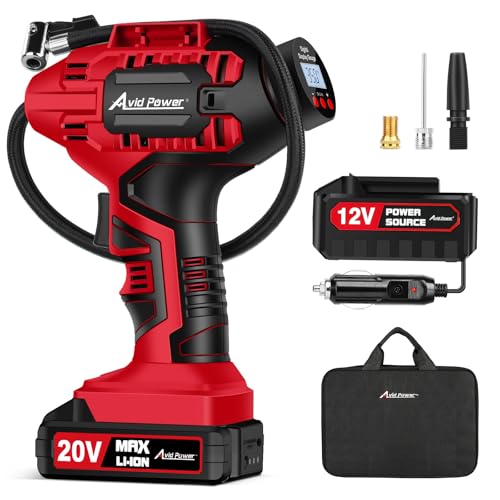
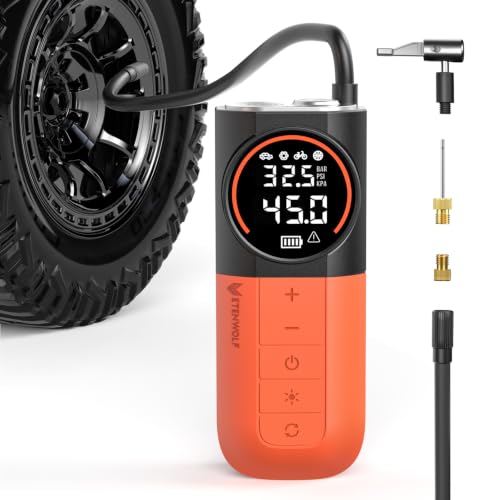
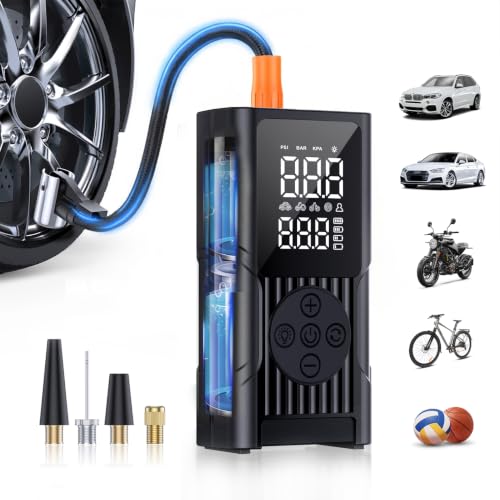
Cordless inflators come in two main styles: standalone units with a built in battery, like AstroAI's L7S and ETENWOLF's S1, and tool platform inflators that use the same batteries as your drills, like DEWALT, Milwaukee and RYOBI. Many also include a 12V car adapter as backup.
Key Specs for the Best Cordless Tire Inflator, Explained in Plain English
For most drivers, look for auto shutoff, a gauge accurate to within 1 to 2 PSI, enough battery for four tires and a compact size.
Vehicle and Tire Compatibility
Match the inflator to your largest tires. Compact inflators handle passenger car tires: CRAFTSMAN says its inflator fills four 195/55 R15 tires from 30 to 36 PSI.
Pickups and off road vehicles need more airflow. ETENWOLF says its Vortex S6 fills a 31 inch tire from 30 to 35 PSI in 1 minute, and Milwaukee says its M18 inflator tops off 33 inch light truck tires in under 1 minute. AVID POWER notes its inflator is not suitable for truck, trailer or heavy duty tires.
Safety Features
Auto shutoff prevents over inflation; AstroAI, AVID POWER, CRAFTSMAN, ETENWOLF and DEWALT all list it. Accurate gauges matter: ETENWOLF lists plus or minus 1 PSI on its Vortex S6 and AVID POWER plus or minus 2 PSI. AstroAI lists intelligent temperature control from minus 4°F to 131°F. Built in LED lights, like ETENWOLF's 1000 lumen light, improve visibility on dark roadsides.
Performance Specs (Airflow, PSI and Fill Time)
Airflow decides speed. ETENWOLF lists 42 L/min (1.5 CFM) for the Vortex S6 and 20 L/min for the S1, and AVID POWER lists 30 L/min. Fill time claims help compare: AstroAI says its 20V model fills a car tire from 30 to 36 PSI in under 40 seconds, and CRAFTSMAN lists 45 seconds. Max PSI of 150 to 160 is plenty; higher numbers do not mean faster filling.
Battery Capacity and Runtime
Battery size decides how many tires you can fill per charge. AstroAI's L7S has a 4000 mAh battery for up to 8 tires topped off, ETENWOLF's S1 a 5200 mAh battery for up to 17 car tires and ETENWOLF's Vortex S6 a 19200 mAh battery for 18 F150 tires. AVID POWER says one charge handles about four 195/60R14 tires from flat to 36 PSI. Tool platform inflators run as long as your spare batteries.
Power Options and Tool Platforms
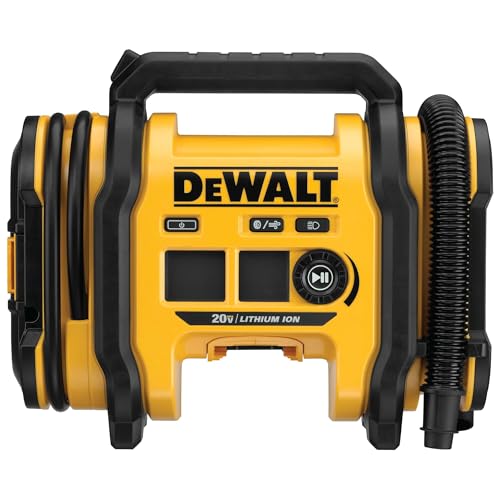
Dual power gives you a backup. AstroAI's 20V and AVID POWER both include a 12V car adapter, and CRAFTSMAN includes a 10 foot 12V plug. DEWALT's DCC020IB runs on 20V MAX batteries, 12V DC or 110V AC, and includes high volume inflation and deflation modes for air mattresses. If you already own DEWALT, Milwaukee M18 or RYOBI ONE+ tools, a bare tool inflator saves money.
Duty Cycle, Cooling and Build Quality
Duty cycle is how long the inflator can run before it needs to rest. ETENWOLF lists a 100% duty cycle on its Vortex S6 with a dual cylinder and cooling system. AVID POWER recommends a 3 minute cool down after 10 to 15 minutes of use and uses an all metal cylinder and metal gears. AstroAI lists durable metal construction, and the L7S includes a silicone sleeve for drop protection.
Features and Extras
Many inflators double as power banks. CRAFTSMAN includes a USB output, AstroAI's L7S has USB C and USB ports and ETENWOLF's Vortex S6 has a 45W USB C port. Preset modes for cars, bikes, motorcycles and balls simplify use. DEWALT includes onboard accessory storage and a threaded chuck, and Milwaukee includes an all brass Schrader chuck and a Presta chuck.
Size, Weight and Storage
Smaller inflators are easier to keep in a glove box, bike bag or backpack. AstroAI's L7S weighs 1.01 pounds and measures 5.31 by 2.71 by 2.04 inches, and CRAFTSMAN's weighs 1.28 pounds. ETENWOLF's S1 stores its hose on the back with slots for the ball needle and Presta adapter. Tool platform inflators are bulkier but sit steadily on the ground; DEWALT uses heavy duty rubber feet to reduce walking while it runs.
Price Ranges
Compact standalone inflators cost around $25 to $40, like AstroAI's L7S and L4 and ETENWOLF's S1. Dual power 20V kits with a battery and 12V cord cost around $55, like AstroAI's 20V model and AVID POWER. Bare tool inflators cost around $64 for RYOBI, around $140 for DEWALT and around $199 for Milwaukee, plus batteries if you do not own them. High output units like ETENWOLF's Vortex S6 cost around $130.
Rookie Mistakes to Avoid
Using the sidewall number as your target. The sidewall shows the tire's maximum, not the recommended pressure; use your door jamb sticker.
Checking pressure on hot tires. Driving raises pressure, so check after the car has sat for a few hours.
Buying for max PSI instead of airflow. Airflow decides fill speed for car and truck tires.
Letting the battery die in storage. A dead inflator is useless in an emergency.
Running it nonstop on big jobs. Small inflators overheat; follow the cool down guidance.
Getting Started: Setup and First Use
Check your owner's manual and door jamb sticker. Note front and rear pressures.
Fully charge the battery before first use. Then recharge every few months, even if unused.
Compare the gauge to a separate tire gauge. This confirms accuracy before you rely on it.
Screw or clamp the chuck firmly onto the valve. A loose fit leaks air and gives false readings.
Set the target pressure and start. Let auto shutoff stop the pump, then recheck.
Store it in the trunk with adapters. Keep it in its bag away from extreme heat.
FAQs
How long does a cordless tire inflator last?
A quality cordless inflator lasts several years with occasional use. Battery capacity slowly fades over hundreds of charge cycles, so recharge every few months and avoid storing it fully drained in a hot car. DEWALT lists a 3 year limited warranty on its inflator.
Do I need a 12V backup cord?
A 12V backup cord is useful if you forget to charge the battery. AstroAI's 20V model, AVID POWER and CRAFTSMAN include 12V car adapters, and DEWALT also runs on 110V AC. Standalone compact inflators without a cord rely only on their battery.
Will it fill my truck or SUV tires?
Compact inflators fill car and small SUV tires but slowly fill larger ones. For pickups and off road tires, choose higher airflow models like ETENWOLF's Vortex S6, rated for 31 inch tires, or Milwaukee's M18 inflator, rated for 33 inch light truck tires.
What specs matter most?
Airflow, gauge accuracy, auto shutoff and battery capacity matter most. Look for gauge accuracy of plus or minus 1 to 2 PSI, enough battery to fill four tires and airflow of at least 20 L/min for cars. Max PSI above 150 rarely matters for car tires.
Are cordless inflator gauges accurate?
Most quality cordless inflators are accurate to within 1 to 2 PSI, which is good enough for everyday driving. ETENWOLF lists plus or minus 1 PSI on its Vortex S6, and AVID POWER lists plus or minus 2 PSI. Compare the reading with a quality handheld gauge once in a while, since sensors can drift over time.
Can a cordless tire inflator fix a flat tire?
No, an inflator only adds air. It can refill a slow leak long enough to reach a repair shop, but a tire with a puncture, bulge or sidewall damage must be repaired or replaced. Never drive on a damaged tire.
The Bottom Line
The best cordless tire inflator fills your tires quickly, shuts off at the right pressure and holds enough charge for an emergency. Compact standalone models like AstroAI's and ETENWOLF's S1 suit most cars, dual power models like AVID POWER and CRAFTSMAN add a 12V backup and tool platform models like DEWALT, Milwaukee and RYOBI suit owners of those batteries. For trucks, choose high airflow units like ETENWOLF's Vortex S6.
For more car care guides, see the best portable tire inflator, the best portable air compressor for car, the best jump starter and air compressor and the best air compressor for home garage. Then compare current prices in the product table above.


