Best 15x Binoculars for Hunting in 2026: A Buyer Checklist
Disclosure: We may earn a commission when you buy through links on this page, at no extra cost to you. As an Amazon Associate I earn from qualifying purchases. Learn more

Open country hunters: the best 15x binoculars for hunting need a steady rest, bright glass and sealed barrels.
A 15x binocular shows distant animals in real detail, but that power only helps when the glass, support and fit suit long sits in open country. The best 15x binoculars for hunting balance a large objective lens, a steady image and enough eye relief for a full view. Use this checklist to judge each pair against the product table.
Start with how and where you hunt. A hunter who glasses basins from a ridge needs a different pair from one who watches a field edge at dawn. Your usual distance, light and support matter more than magnification alone.


Who Should Buy 15x Binoculars for Hunting?
Power this high suits a narrow job done well. It rewards patience, a steady rest and country where animals feed far beyond the range of a standard 10x pair.
Western Hunters Glassing Basins and Distant Slopes
You watch mule deer or elk across canyons where judging antlers happens at a mile or more. A 15x view lets you study an animal without walking closer and pushing it out of the basin. Choose a pair built for a tripod and glass in turns, because long sessions tire your eyes faster.
Hunters Who Sit at a Fixed Vantage Point
You set up on a ridge, a field corner or a raised stand and stay put while the light changes. Weight matters less to you than clarity, since the binocular rests on a tripod instead of hanging on your chest. Time to scan slowly turns 15x power into a real advantage.
Field and Clearing Hunters Watching Deer at Distance
You watch deer cross large crop fields, power line cuts or open meadows where sightings stretch long. A 15x pair helps you tell a legal buck from a doe at the far edge before either one reaches cover. If that is your ground, see our guide to the best binoculars for deer hunting for choices shaped by whitetail cover and closer ranges.
Key Features to Compare
Compare these factors in order, because a fault in any one can cancel the reach that drew you to 15x. Lens size and steadiness come first.
Objective Lens Size and Exit Pupil for Dawn and Dusk
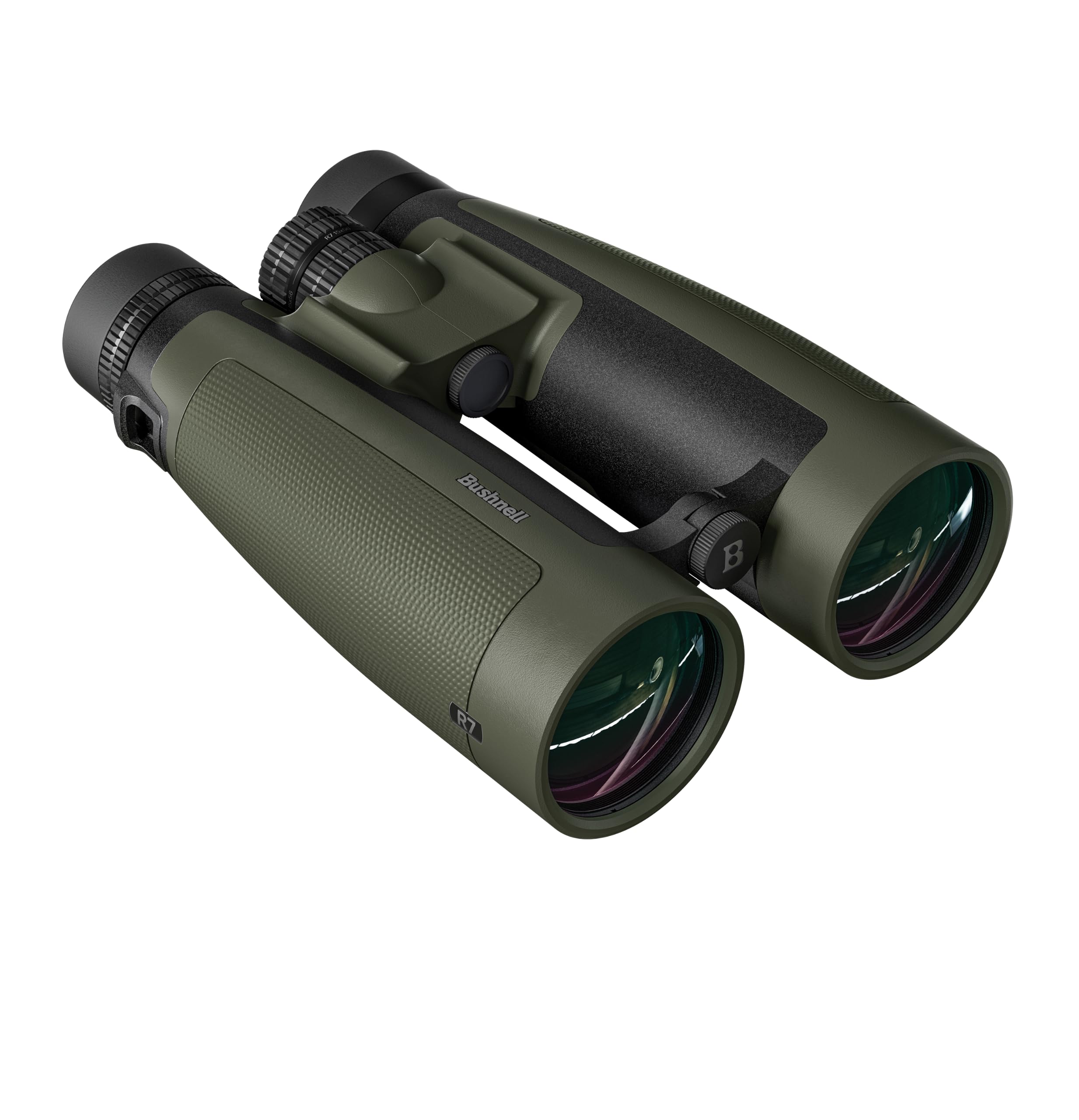
Most full size binoculars at this power pair 15x magnification with a 56 mm objective lens, written as 15x56. Divide 56 by 15 and you get an exit pupil of about 3.7 mm, the beam of light that reaches your eye. That beam is ample in daylight but smaller than the pupil of your eye at dusk, so a 15x56 looks dimmer in last light than a 10x42 does.
Field of View and Why 15x Narrows Your Search
Field of view tells you how much country fits in the frame, and at 15x it often falls to about 210 to 240 feet at 1,000 yards. A narrow view makes finding a moving animal slower, since a small turn sweeps past it. Scan in slow, overlapping strips and mark a landmark before you raise the binocular. If you spot animals by movement in brush, a wider view will serve you better.
Glass, Prism Coatings and Edge Clarity
At 15x, weak glass shows up fast as color fringing on antlers against a bright sky and as soft edges that blur ear tips and tines. Look for extra low dispersion glass, phase coated roof prisms and fully multi coated lenses, which keep contrast high in shadow. BaK 4 prisms pass light more cleanly than cheaper prism glass. Judge the outer third of the view too, because edge softness grows as power rises.
Image Steadiness and Tripod Support
Every small shake of your hands grows with magnification, and at 15x even your pulse can move the image enough to hide detail. A tripod adapter that screws into the front hinge solves most of that, so check that the pair you want accepts one. A monopod also helps during short looks. Plan on supported glassing as the normal way to use this power.
Eye Relief, Focus Wheel and Diopter Adjustment
Eye relief of about 15 to 18 mm lets glasses wearers see the full frame without dark edges, and twist up eye cups set the right distance for everyone else. The center focus wheel should turn smoothly with a gloved fingertip and hold its setting in a pack. A locking diopter ring balances your two eyes once, then stays put. Set it while rested, since tired eyes give a false reading.
Weather Sealing, Armor and Carry Weight
Hunting glass gets rained on, fogged by cold mornings and knocked against rocks, so sealed and purged construction matters. Look for waterproof sealing and fogproof purging with nitrogen or argon, plus rubber armor that guards the barrels and improves grip with wet gloves. Most 15x56 pairs weigh about 38 to 48 ounces, which is why a chest harness spreads the load better than a neck strap. For support gear, see our guide to the best binoculars harness for hunting.
Types of 15x Hunting Binoculars and a Quick Buyer Checklist
Most pairs fall into three groups. Roof prism 15x56 models are the common choice, with straight barrels, sealed bodies and prices often about $300 to $900 depending on glass quality. Porro prism models cost less, often about $150 to $300, but they are wider, heavier and harder to seal well. Image stabilization models steady the view electronically, though they add batteries and cost.
To see how this power compares with hunting glass in general, see our guide to the best rated binoculars for hunting. For this magnification without the hunting focus, see our guide to the best 15x binoculars. Then run the checklist below for your own ground.
- Do you glass animals beyond about 800 yards in open country?
- Can you mount the pair on a tripod for long sessions?
- Does the objective size suit the light you hunt in?
- Is the eye relief long enough if you wear glasses?
- Can you carry about 38 to 48 ounces for a full day?
- Is the body sealed against rain and purged against fog?
- Does the focus wheel turn smoothly in hunting gloves?
Mostly yes answers point to a sound match. Two or more no answers on support, light or carry mean a 10x or 12x pair will find you more animals. Reach only counts when you can hold it steady.
Common Mistakes to Avoid
Each of these errors costs you sightings or money.
- Buying 15x power for timber and brush leaves you with a view too narrow to find animals before they slip away.
- Glassing freehand for long periods blurs fine detail, so you misjudge antlers you could have judged from a tripod.
- Ignoring exit pupil leaves you with a dim image at dusk, right when deer and elk move most.
- Choosing the lightest pair you can find often means smaller lenses and weaker glass that dim the whole view.
- Skipping a harness strains your neck within an hour and leaves heavy glass swinging against your chest as you walk.
Care and Maintenance for 15x Hunting Binoculars
Keep the lens caps on whenever the binocular hangs or rides in a vehicle, because grit on a large objective lens is the most common cause of fine scratches. Blow loose dust off first, then wipe with a clean lens cloth in small circles. Never use a shirt, since trapped grit drags across the coating.
After a wet hunt, leave the pair uncased at room temperature until the armor and eye cups feel dry, then store it in a padded case in a dry place. Check hinge tension and adapter threads before each season. If fog appears inside a lens, that seal has failed and needs factory service. Handled this way, the best 15x binoculars for hunting stay clear for many seasons.
FAQ
Are 15x binoculars too shaky to use by hand for hunting?
Yes, for long glassing sessions 15x binoculars are too shaky to use by hand for most hunters. Short looks while seated with your elbows braced on your knees can work for a quick check of an animal you already found. Try reading a distant sign freehand for ten seconds. If the letters swim, plan on a tripod.
What does 15x56 mean on hunting binoculars?
On hunting binoculars, 15x56 means the image looks 15 times closer and each front lens measures 56 mm across. The second number drives size and weight more than the first, which is why two pairs with the same power can feel very different on a harness. A 15x70 adds bulk that few hunters want to carry beyond a vehicle.
Can 15x binoculars replace a spotting scope for hunting?
For many open country hunts, 15x binoculars on a tripod can cover the work a small spotting scope would do. Two eyes tire less than one during long glassing, and the wider view helps you relocate an animal after you look away. A scope still wins past about a mile and a half when you must count points with certainty.
Are 15x binoculars a good choice for hunting in thick timber?
No, 15x binoculars are a poor choice for hunting in thick timber. Sight lines there often run under 100 yards, where a wide view and fast focus matter far more than reach. Depth of field also shrinks at 15x, so animals at mixed ranges fall out of focus as they move. Timber hunters usually do better carrying 8x glass.
How far can you judge antlers with 15x binoculars while hunting?
You can judge antler shape and rough size with 15x binoculars at roughly 800 to 1,200 yards in clear morning air. Heat shimmer rising off sun warmed ground shortens that range fast, since waves in the air blur tines no matter how good the glass is. Glass early, and treat any judgment made through heavy shimmer as a first guess.
Wrapping Up
Choose on steadiness, brightness and fit before you chase more reach. A supported 15x56 with clean glass, honest eye relief and sealed barrels will show you animals that a shaky or dim pair hides. Use the product table above to check lens size, weight and support options.
When you compare best 15x binoculars for hunting with your ground and your light in mind, the right pair is the one you can hold still at dawn. Buy for the hunt you repeat most, and mount it well.