Best Home Garage LED Lighting: A Complete Buying Guide
Disclosure: We may earn a commission when you buy through links on this page, at no extra cost to you. As an Amazon Associate we earn from qualifying purchases. Learn more

Flip the switch in most garages and you get one thing: shadows. A single ceiling bulb or whatever fixture the builder installed years ago rarely covers the whole slab, let alone a workbench in the corner or shelving along the back wall. Upgrading to garage LED lighting fixes that problem for less money and less hassle than most homeowners expect, and it typically pays for itself in energy savings within a couple of years. This guide walks through how much light your garage actually needs, which fixture styles fit different layouts, and how to get power to them safely, so you can shop with confidence instead of guessing.











How Bright Your Garage Really Needs to Be
Lumens per Square Foot for Parking, Storage, and Workshop Zones
A garage used mainly for parking and storage does fine with roughly 20 to 30 lumens per square foot. Once you add a workbench, a bike repair stand, or anything involving hand tools, that number should climb closer to 50 lumens per square foot so you can see fine detail without working in your own shadow. How the space is organized, from wall-mounted storage systems to a dedicated workbench, changes where those lumens need to land, not just how many you end up buying.
Total Output for One-Car, Two-Car, and Three-Car Garages
Translate that per-square-foot number into a shopping list by multiplying it by your garage's square footage. A one-car garage, around 200 to 250 square feet, generally needs 10,000 to 15,000 total lumens for general use. A standard two-car garage, closer to 400 to 500 square feet, lands in the 20,000 to 25,000 lumen range, and a three-car or workshop-heavy space can call for 30,000 lumens or more. Buying two or three linkable fixtures rather than one oversized unit makes it easier to spread that output evenly across the ceiling.
Getting the Light Temperature and Color Rendering Right
Why 4000K and 5000K Look So Different on Concrete and Drywall
Color temperature, measured in Kelvin, determines whether light reads as warm or stark. Most garage lighting falls between 4000K and 5000K. 5000K is the closest match to daylight and makes it easiest to judge paint colors, wire insulation, and rust or corrosion accurately, which is why it's the default recommendation for workshop use. 4000K is a touch warmer and softer, and it's a reasonable compromise if the garage also doubles as a hangout space or home gym rather than a pure work zone.
When a Higher CRI Rating Is Worth Paying For
Color rendering index, or CRI, measures how accurately a light source reveals true colors compared with natural sunlight. A CRI of 80 or above is fine for parking, storage, and general maintenance. If you paint, stain wood, match touch-up paint, or work with color-coded wiring on a regular basis, look for a CRI of 90 or higher instead. That rating is usually printed right on the packaging or spec sheet, so it's worth checking before you buy rather than assuming every fixture measures up the same way.
Fixture Styles Made for Garage Ceilings
Not all garage lighting looks the same once it's mounted overhead, and picking the wrong shape for your ceiling height and layout is one of the more common regrets buyers mention after installing a new fixture.
Linkable Linear Shop Lights
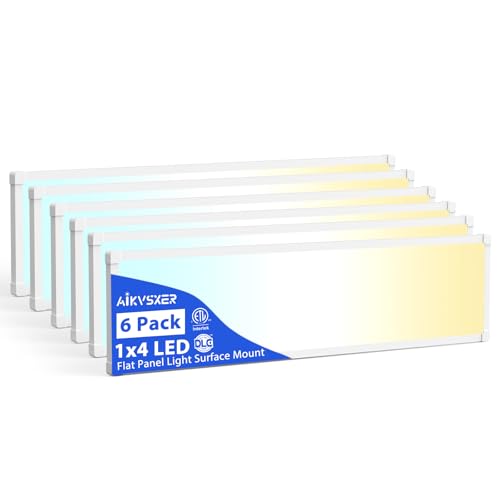
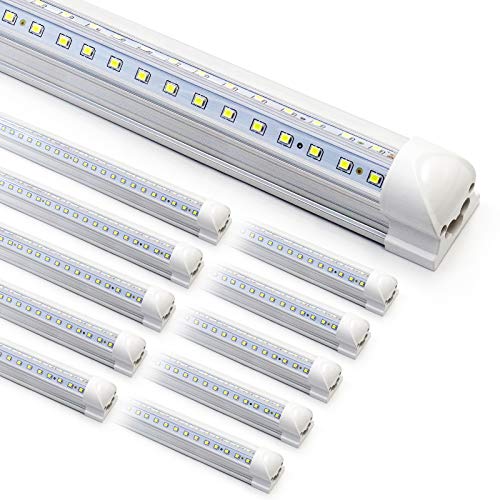
These are the 4-foot or 8-foot fixtures most people picture when they think of shop lighting. Their biggest advantage is the ability to daisy-chain two, three, or four units together and run the whole string from a single outlet or switch, which makes it easy to scale coverage as your needs grow. They mount directly to the ceiling with hanging chains, brackets, or a flush kit, and most models ship with both options included.
Flush Mount and Wraparound Fixtures
Flush mount and wraparound fixtures sit tighter against the ceiling and spread light in a wider pattern, which suits garages with lower ceilings or anywhere headroom is already tight, such as over a tool chest area or a low workbench. They read as more finished and are a common choice for garages that also serve as a home gym or hobby space.
Adjustable Panel Lights for High or Sloped Ceilings
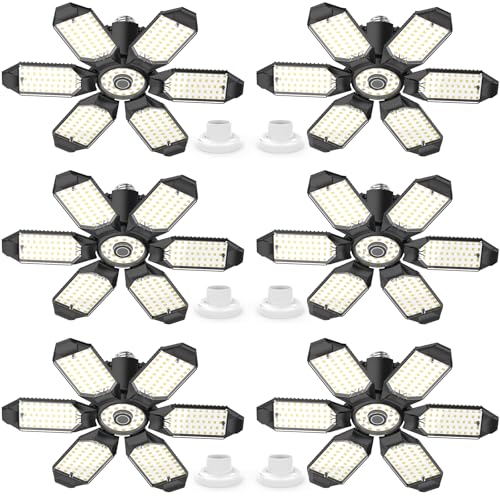
For garages with vaulted or sloped ceilings, adjustable multi-panel fixtures let you tilt individual panels toward corners or specific work areas instead of pointing everything straight down. This style is also common in detached workshops and larger three-car garages, where a single fixture needs to cover more floor area from a higher mounting point.
Powering and Mounting Fixtures Without Tripping a Breaker
Getting the electrical side right matters as much as picking the fixture itself, especially in an older garage where a single circuit already does double duty for lights, outlets, and a garage door opener.
Plug-In Convenience vs a Hardwired Switch Leg
Plug-in fixtures use a standard cord and plug into an existing outlet, which makes them the simplest option if you're not comfortable working inside a junction box. Hardwired fixtures connect directly to a switch leg for a cleaner look with no visible cord, but that usually means shutting off the breaker and tying into existing wiring, or hiring an electrician if the garage doesn't already have a switched circuit in place. Pairing a hardwired circuit with a smart switch lets you schedule the lights or control them remotely without adding a separate smart bulb to every single fixture.
How Many Fixtures One Circuit Can Safely Run
A standard 15-amp household circuit at 120 volts supports roughly 1,440 watts before you're pushing safe limits, and most electricians recommend staying well under that for continuous loads. Since a typical LED shop light draws 40 to 60 watts, that leaves plenty of headroom for four to six fixtures on one circuit, but always check the wattage printed on the box rather than assuming, and never chain more fixtures than the manufacturer rates for a single run.
Mounting Height and Spacing for Even Coverage
Standard garage ceilings run 8 to 10 feet, and most linear fixtures perform best mounted flush or within a few inches of the ceiling at that height. Space fixtures evenly across the width of the garage rather than clustering them in the center, and stagger rows if you're covering more than one bay so the light overlaps instead of leaving dim strips between fixtures.
Built for a Garage, Not a Living Room
Because garage LED lighting lives in a space most HVAC systems don't fully condition, ratings matter more here than they would in a finished room. Look for a damp location rating at minimum, since garages see humidity swings, dust, and sometimes direct exposure near an open door. If your garage doubles as a workshop with a wall-mounted air compressor running power tools, dust and vibration are additional reasons to pick a rated fixture instead of one meant for a bedroom or office.
Motion and occupancy sensors are worth considering if you're constantly walking in and out with your hands full, though they can be more hassle than help in a workshop where you're standing still at a bench for long stretches and the light keeps timing out on you. Many linkable fixtures now offer a sensor as an optional add-on rather than building it in, so you can decide per fixture instead of committing the whole setup to one behavior.
Frequently Asked Questions
How many lumens do I need for garage LED lighting?
Aim for 20 to 30 lumens per square foot for general parking and storage, and closer to 50 lumens per square foot if you use the space as a workshop. For a standard two-car garage, that works out to roughly 20,000 to 25,000 total lumens.
What color temperature is best for a garage?
5000K is the most common recommendation because it closely mimics daylight and makes it easier to judge color accurately. 4000K works well if the garage also serves as a living or hangout space and you want something slightly warmer.
Can I link multiple garage LED fixtures together?
Most linear shop lights support daisy-chaining, typically two to four fixtures per run from a single outlet or switch. Check the manufacturer's rated chain limit before connecting more than that, since exceeding it can overload the connection.
Do I need an electrician to install garage LED lighting?
Plug-in fixtures don't require an electrician since they connect to an existing outlet like any other appliance. Hardwiring a new switch leg or tying into existing wiring is more involved, and it's worth hiring an electrician if you're not comfortable working inside a breaker panel or junction box.
What's the difference between a garage light fixture and a portable work light?
A garage light fixture mounts permanently to the ceiling and lights the whole space evenly, while a portable work light is meant to be moved and aimed at a specific task, like the underside of a car or a dark corner a ceiling fixture doesn't reach well. Many garages benefit from having both instead of relying on just one.
Do garage LED lights need to be damp rated?
At minimum, yes. Garages see more humidity, dust, and temperature swings than a typical indoor room, and a damp-rated fixture is built to handle that without corroding or failing early. Fixtures rated for wet locations go a step further and are worth it if the garage door is open often or the space isn't fully enclosed.
Putting the Right Setup Together
Start with square footage and how you actually use the space, not whichever fixture looks brightest on the box. Once you know your target lumens, matching color temperature and CRI to the work you do, and confirming your circuit can handle the load are the details that separate a garage that finally feels usable from one that still leaves you squinting in the corners.