
Best Collapsible Salad Spinners (2026): How to Choose One That Fits Your Kitchen
Disclosure: We may earn a commission when you buy through links on this page, at no extra cost to you. As an Amazon Associate I earn from qualifying purchases. Learn more

Compare the best collapsible salad spinner styles by capacity, drive type and materials to find a folding model that suits your kitchen and your storage space.
You open the cabinet to put away the groceries and the same problem stares back at you. A rigid salad spinner takes up as much room as a large mixing bowl, yet you only use it a few times a week. A collapsible model solves that trade off, because the bowl folds down to a fraction of its working height and slides into a drawer or a slim shelf gap. Finding the best collapsible salad spinner for your home comes down to three things: the space you can give it, how many people you feed, and what you can spend.
This guide walks through the sizes, drive styles, and materials that matter, then compares the main types so you can match one to your routine. Start with the comparison table below for a fast overview.


Quick Answer: The Short Version
If your storage is tight and you cook for one or two people, a compact collapsible spinner in the 2 to 3 quart range is usually enough. Households of three to five do better with a full size model around 5 to 6 quart that still folds flat for storage. If you are comparing formats before you commit, our guide to the best salad spinner covers rigid and collapsible designs together.
Before You Buy: A Quick Checklist for Choosing a Salad Spinner
A collapsible spinner looks simple, but small details decide whether it earns its drawer space or frustrates you every wash day. Work through the five points below before you order, and measure your storage spot first, because folded height is the whole reason this style exists.
Size: Match It to Your Space
Capacity is listed in quarts, and it should match both your household and your shelf. Small and mini models hold about 2 to 3 quarts, which suits salads for one or two people and small bunches of herbs. A 5 quart bowl handles a family salad with room for leaves to move, and that movement is what lets water fly off. Larger 6.2 quart versions serve bigger gatherings but need a wider drawer or cabinet even when folded. Check the folded height against your drawer depth. If every inch counts, compare the compact options in our roundup of the best small salad spinner models as well.
Which Type Fits Your Routine
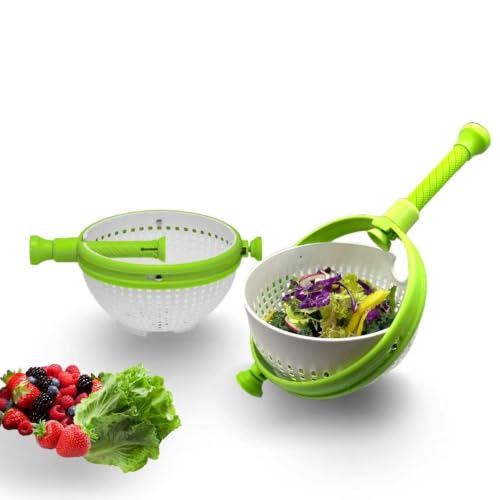
The drive style changes how the basket spins. A pump top lets you press down with one hand, which many people find steady and easy on the wrists. A pull cord builds speed quickly and needs no downward force, though the cord and its housing add a part that can wear over time. A crank handle gives you direct control of the speed, useful when you spin delicate berries or soft herbs and want a gentler pace. All three styles appear in collapsible designs, so choose by comfort and by how often you spin.
Materials and Food Safety
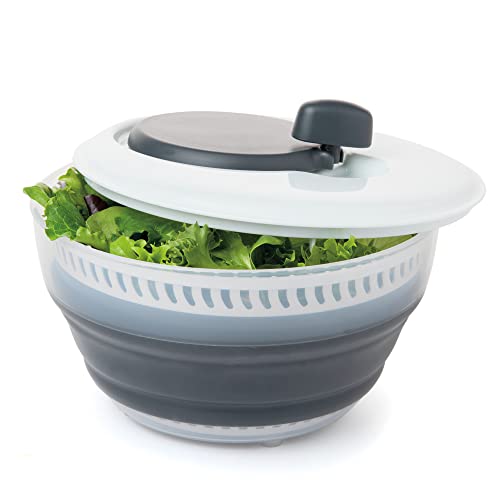
Most collapsible bowls pair a flexible silicone wall with a rigid plastic rim and base, and that silicone section is the part that folds thousands of times over the life of the product. Look for food grade silicone and BPA free plastic, stated plainly by the maker. Silicone resists stains and odors better than many plastics. The inner basket is usually plastic with wide slots, so check that the slots are smooth and sturdy rather than thin and sharp. If you prefer metal and do not mind giving up the folding feature, the models in our guide to the best stainless steel salad spinner show what that trade looks like.
Dishwasher Safe or Hand Wash
Cleaning decides whether you reach for the spinner or skip it. Many collapsible models are safe on the top rack of a dishwasher, but the lid with the drive mechanism inside often needs hand washing, because water and heat can damage the gears or the cord. A bowl and basket that separate fully rinse faster and dry without trapped moisture in the folds. If your routine leans on the dishwasher for everything, confirm which parts are rated for it before you buy. Our step by step guide on how to clean a salad spinner explains how to wash each part without warping it.
Realistic Budget Ranges
Collapsible spinners cluster into three price bands. Under $20 you get basic small models with simple pump or cord drives and thinner walls, fine for light use. About $20 to $30 covers most full size family models with sturdier silicone and better lids, and this is where most homes find the right balance. About $30 to $50 buys heavier construction, smoother mechanisms, and details like a brake button that stops the basket fast and a spout for pouring off water. Spending more mainly buys durability and comfort, not better drying, so do not pay for features your routine will never use.
Types Compared: Three Styles Worth Your Money
Instead of naming specific models, it helps to compare the three styles you will meet in this category. Each suits a different home, and the product table above lists current options in each style.
Compact Everyday Style for Small Kitchens
This style holds about 2 to 3 quarts, folds the flattest, and often weighs the least, so it suits apartments, dorm rooms, and RV kitchens where storage is measured in inches. The pump or cord drive keeps the footprint small, and the whole unit can live in a deep drawer. The trade off is batch size, because a big head of lettuce needs two or three loads. For one or two people who eat salads a few times a week, that extra load is a fair price for a tool that never crowds the counter.
Full Size Family Style With a Silicone Wall
The family style holds about 5 to 6 quarts when open and still folds to roughly half its height, so it handles a large salad in one load and then stores on a shelf. Walls are usually thicker silicone with a reinforced rim, and many lids add a brake and a locking clip so the basket does not creep while it spins. This is the style most households settle on, because it balances capacity, storage, and price in the middle band.
Heavy Duty Hybrid Style for Daily Use
The heaviest collapsible style pairs a silicone midsection with rigid top and bottom sections, larger lids, and the smoothest drive parts in the category. It costs the most, around the upper band, and it folds a little less flat than the compact style because the rigid sections keep their shape. In return you get a base that stays planted at high speed and parts that feel built for daily spinning over many years. Homes that wash greens every single day, or that spin heavy loads like chopped cabbage and washed potatoes, get the most from this extra strength.
Our Selection Process for Collapsible Salad Spinners
We judge this category on five criteria: ease of use, durability, cleaning, design, and value. Ease of use covers the drive motion, lid fit, and whether the bowl stays steady while it spins. Durability focuses on the folding wall and the mechanism, the two parts that wear first. For cleaning we weigh how fully the unit comes apart and which parts tolerate a dishwasher. Our notes draw on maker specifications and patterns in verified buyer feedback, and we favor designs whose strengths match how real homes store and use a spinner.
What We Like and What We Don't About Collapsible vs Other Salad Spinners
The clear win is storage. A folded spinner takes the space of a dinner plate stack, while a rigid one claims a full cabinet bay. Collapsible bowls also travel well to picnics, and most double as a colander for rinsing and a bowl for serving. The honest trade offs are capacity and feel. Folding walls flex a little under a heavy load, and the creases need a careful rinse so residue does not build up. If storage is not a problem and you want hands free speed, the powered models in our guide to the best electric salad spinner are the alternative worth a look. For most space limited homes, the folding design gives up little and returns a whole shelf.
Common Buying Mistakes to Avoid
- Buying by open capacity only and never checking the folded height, so the spinner still does not fit the drawer you bought it for.
- Choosing a bowl too small for your household, which forces load after load and makes you dread using it.
- Ignoring the lid mechanism when you compare prices, even though a worn cord or a loose pump is the most common reason these tools get replaced.
- Paying for extras like herb baskets and slicing inserts you will not use, instead of putting that money toward a sturdier wall and lid.
- Assuming every part can go in the dishwasher and warping a drive lid that was meant for hand washing only.
Cost of Ownership and Care
A collapsible spinner has no running costs, no filters, and no parts you must replace on a schedule. The real cost of ownership is care. Rinse the bowl and basket soon after use so leaf residue does not dry into the folds, wash the silicone wall with warm soapy water, and let every part dry fully before you fold it away, because trapped moisture in a crease can leave odors. New users can also read our guide on how to use a salad spinner for loading and spinning technique that keeps the mechanism smooth.
Your Questions, Answered
Are collapsible salad spinners worth it?
Yes, if storage space is your main limit. A collapsible model dries greens about as well as a rigid one of the same size, and it stores in a drawer or a narrow shelf gap where a rigid bowl cannot go. It is less worthwhile if you have plenty of cabinet room and spin very large loads daily, because rigid bowls feel sturdier under heavy use. Judge it by your shelf, not by the feature list.
Can a collapsible salad spinner go in the dishwasher?
Usually the bowl and basket can, on the top rack, but the lid often cannot. The lid holds the pump, cord, or crank parts, and dishwasher heat plus detergent can shorten their life. Check the care notes for your model, and when in doubt wash the lid by hand with a damp cloth. Letting all parts air dry before folding also keeps the silicone from holding wash day smells.
How long does a collapsible salad spinner last?
With normal home use and gentle care, expect several years of service. The folding wall usually outlasts the drive, so the lid mechanism is the part to treat kindly: avoid yanking a pull cord to its limit and do not force a pump that feels stuck. If the basket starts to wobble or the wall develops a tear at a fold, drying performance drops and replacement makes more sense than repair.
Is a salad spinner worth it if you only eat salad once a week?
It can be, because dry leaves hold dressing better and keep longer in the fridge, so a weekly salad tastes fresher and your greens waste less. A collapsible model lowers the commitment, since it asks for almost no storage in return. If you mostly buy bagged greens that come washed and dry, you may not need one at all. Occasional users should stay in the lower price bands and skip the heavy duty style.
What size collapsible salad spinner suits a family of four?
Aim for about 5 to 6 quarts of open capacity. That size takes a full family salad in one load, including bulky leaves that need room to shed water. Smaller models work, but you will spin two or three batches, which adds minutes on busy nights. Also confirm the folded height fits your storage spot, because family size models fold less flat than compact ones and need a shelf or a deep drawer.
Final Thoughts
The right choice depends on your shelves and your table. Compact styles serve small kitchens, full size silicone wall models suit most families, and heavy duty hybrids reward daily use. Compare the product table above, measure your drawer, and pick the best collapsible salad spinner that fits both your space and your routine, and it will quietly earn its place in your kitchen.


