The Best Carving Knives: Buying Guide and Top Picks for 2026
Disclosure: We may earn a commission when you buy through links on this page, at no extra cost to you. As an Amazon Associate I earn from qualifying purchases. Learn more

The best carving knives from Dalstrong, Cutluxe and MASAMOTO, plus a guide to steel, blade length and care.
A holiday turkey, a smoked brisket or a Sunday roast deserves clean, even slices, yet many home cooks reach for a chef's knife that is too short and too thick for the job. A good carving knife has a long, narrow blade that glides through meat in one stroke instead of sawing and shredding it. This guide to the best carving knives explains the features that matter, the mistakes to avoid and our top picks so you can buy with confidence.
We start with three short picks, then cover blade steel, forging, edge angle, length, balance, storage, carving knife types, care and common questions. Always carve on a stable board that will not slide, hold the meat with a carving fork rather than your fingers, cut away from your body and store long blades in a sheath or block out of children's reach.





Our Top 3 Picks at a Glance
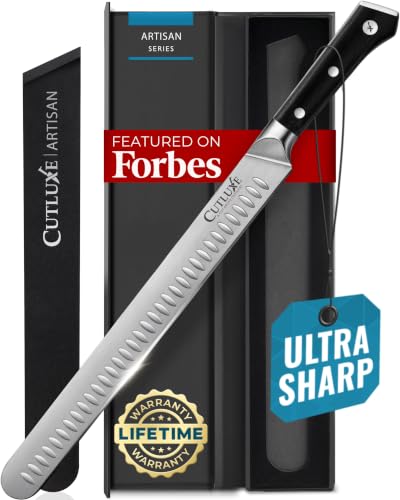
Our picks are the Dalstrong Gladiator Elite 12 Inch Brisket Slicing and Carving Knife as the best overall, the Cutluxe 12 Inch Brisket Knife as the best value and the MASAMOTO AT Sujihiki Slicing Knife as the best premium pick.
We compared blade length, steel, hardness, edge angle, blade shape, handle construction, balance, storage, warranty and price, along with the overall pattern in owner feedback. We did not carve with these knives ourselves; the notes reflect maker specifications.
Best Overall: Dalstrong Gladiator Elite 12 Inch Brisket Slicing and Carving Knife
The Dalstrong Gladiator Elite suits home cooks and barbecue fans who carve large roasts, briskets and holiday turkeys, at around $99. Dalstrong lists a 12 inch blade for long carving strokes, a Granton edge with recesses that reduce food sticking, a long and narrow slicing profile for thin slices, German steel construction with a full tang and a triple riveted G10 handle. A fitted protective sheath is included for storage.
Two strengths stand out: reach for the largest cuts and a durable G10 handle that resists moisture.
The limitation is length; a 12 inch blade can feel unwieldy for small roasts or a single chicken.

Best Value: Cutluxe 12 Inch Brisket Knife
The Cutluxe brisket knife suits beginners and occasional carvers who want a capable slicer for around $33. Cutluxe lists a Granton blade hand sharpened at 14 to 16 degrees per side, high carbon German steel at 56+ Rockwell hardness that resists rust and stains, a full tang design, a triple riveted pakkawood handle, a sheath and a lifetime warranty against material or workmanship defects.
Its strengths are a sharp edge for the price and a lifetime warranty.
The trade off is a softer steel than premium Japanese blades, so it needs honing more often to keep its edge.

Best Premium Pick: MASAMOTO AT Sujihiki Slicing Knife
The MASAMOTO AT Sujihiki suits serious cooks who want a Japanese slicer for meat and fish, at around $196 for the 9.4 inch (240 mm) blade. MASAMOTO lists Japanese high carbon molybdenum vanadium stainless steel at HRC 57, a long narrow blade for trimming sinew and slicing brisket or boneless fish, a full tang with a stainless bolster and a non slip pakkawood handle. It is made in Japan by a maker founded in 1866, and a 10.6 inch (270 mm) version is also sold.
The appeal is precise, thin slices and a blade that is easy to sharpen.
The limitation is no Granton recesses and a higher price than German style slicers.

How to Choose the Best Carving Knives: Buying Guide
Choose by what you carve most, then match blade length, edge style and steel to that job. A 10 to 12 inch slicer covers most home needs.
Blade Steel (German vs Japanese, Carbon vs Stainless)
German steels, like Cutluxe and Dalstrong, are usually around 56 to 58 HRC, tougher and more forgiving if you hit bone. Japanese steels, like MASAMOTO's molybdenum vanadium at HRC 57 and HOSHANHO's ice hardened blades, hold a finer edge. High carbon stainless steel balances edge retention with rust resistance. Pure carbon steel takes a very sharp edge but rusts and stains if left wet.
When comparing the best carving knives, look for a stated hardness rating and high carbon stainless steel for an edge that lasts through many holiday meals.
Forged vs Stamped Blades
Forged blades, like Cutluxe's, are shaped from heated steel and are usually heavier with a bolster for balance. Stamped blades are cut from sheet steel, lighter and cheaper. Both can perform well. Full tang construction, where the steel runs through the handle, adds strength and balance; Dalstrong, Cutluxe, MASAMOTO and SYOKAMI all list full tangs.
Sharpening and Maintenance Needs
All carving knives need honing and occasional sharpening. Hone with a steel rod before each heavy use, and sharpen on a whetstone or quality sharpener once or twice a year. Hand wash and dry immediately; dishwashers dull edges and damage wood handles. MASAMOTO notes its AT steel is easy to sharpen.
Edge Angle and Sharpness
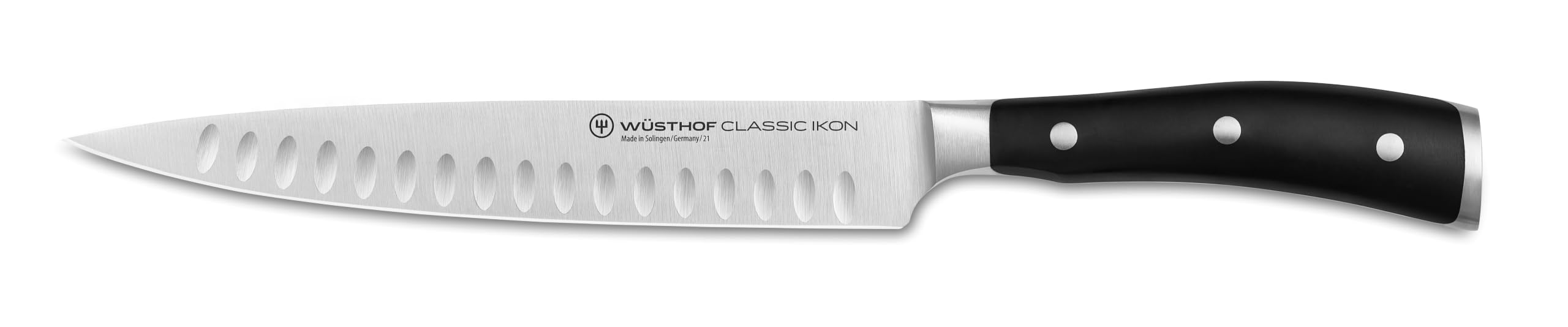
Smaller edge angles cut more cleanly but need more care. HOSHANHO lists 15 degrees per side, SYOKAMI 13 to 15 degrees and Cutluxe 14 to 16 degrees. Traditional German knives use about 20 degrees, which is tougher but less sharp. Granton or hollow edges, like Dalstrong, Cutluxe and Wüsthof's Classic IKON hollow edge, add recesses that reduce sticking.
Blade Length and Shape
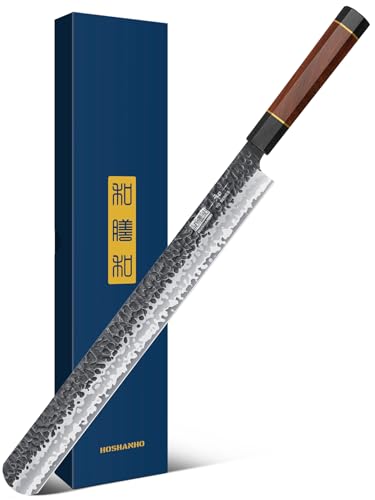
Blade length decides how cleanly you slice. An 8 to 10 inch carving knife suits poultry and small roasts, while 12 inch slicers like Dalstrong, Cutluxe and HOSHANHO handle brisket and large hams in one stroke. Pointed tips work around bones and joints; rounded tips suit boneless slicing.
Weight and Balance
A carving knife should feel balanced near the bolster, so the blade glides without wrist strain. HOSHANHO says its 12 inch knife has a light hand feel and a balanced point. Lighter Japanese knives suit precision slicing, while heavier German knives push through dense roasts.
Storage Block, Magnetic Strip, or Sheath
Long blades need safe storage. Sheaths, included with Dalstrong and Cutluxe, protect the edge in drawers.
Magnetic strips keep knives visible and dry. Knife blocks must have slots long enough for 12 inch blades. Never toss carving knives loose in a drawer.
Types of Carving Knives
Here are the main carving knife types and who each suits.
Classic Carving Knives
Classic carving knives, like Wüsthof's Classic IKON 8 inch hollow edge carver, have pointed tips and 8 to 10 inch blades for poultry and roasts with bones. They maneuver around joints easily. They suit holiday turkeys and roast chickens.
Brisket and Slicing Knives
Brisket and slicing knives, like Dalstrong, Cutluxe, HOSHANHO and MASAMOTO's Sujihiki, have long, narrow 10 to 12 inch blades for thin, even slices. They suit barbecue, ham and boneless roasts, though they are less nimble around bones.
Carving Knife and Fork Sets
Carving sets, like ZWILLING's Professional S 2 piece set and HexClad's Damascus carving knife and fork set, pair a knife with a fork that holds meat steady. SYOKAMI's set pairs a 12 inch slicer with a 6.7 inch flexible boning knife. Sets suit holiday hosts and make good gifts.
Electric Carving Knives
Electric carving knives, like Hamilton Beach's, Black+Decker's and Cuisinart's, use reciprocating serrated blades that saw quickly through meat and bread. Black+Decker's blades never need sharpening and are dishwasher safe, and Cuisinart lists a 3 year limited warranty. They suit anyone with hand strength limits, though slices are less refined.
Setup and Care Tips
Hand wash and dry immediately. Water and detergent dull edges and damage wood handles.
Hone before each heavy use. A few strokes on a honing steel realign the edge.
Use wood or plastic cutting boards. Glass, stone and metal boards dull blades quickly.
Sharpen 1 to 2 times per year. Use a whetstone or quality sharpener when honing no longer restores the edge.
Let roasts rest before carving. Resting 10 to 20 minutes keeps juices in and makes slicing cleaner.
Unplug electric knives before changing blades. Use the safety lock on models like Black+Decker and Cuisinart.
Frequently Asked Questions
Are expensive carving knives worth it?
Expensive carving knives are worth it if you carve often. Premium blades like MASAMOTO's hold a finer edge and resist wear longer. For occasional holiday carving, a budget knife like the Cutluxe brisket knife with a lifetime warranty works well.
Can carving knives go in the dishwasher?
Most carving knives should not go in the dishwasher. Heat, detergent and rattling dull edges and damage handles. Hand wash and dry right away. Some electric knife blades, like Black+Decker's, are dishwasher safe.
How often should I sharpen a carving knife?
Sharpen a carving knife once or twice a year with regular home use, and hone it before each heavy carving session. If the knife tears meat or slides off the surface, it needs sharpening.
Are Japanese carving knives better than German ones?
Neither is better for everyone. Japanese knives like MASAMOTO hold a finer edge for thin slices, while German knives like Cutluxe are tougher and more forgiving around bones. Choose Japanese for precision and German for durability.
What carving knife does a home cook really need?
Most home cooks need one 10 to 12 inch slicing knife with a Granton edge and a carving fork. Add an 8 inch carving knife if you often carve poultry with bones, or an electric knife if hand strength is limited.
Final Thoughts
The best carving knives combine a long, narrow blade, a sharp and durable edge and a balanced, secure handle. The Dalstrong Gladiator Elite is the best overall for large roasts and brisket, the Cutluxe brisket knife is the best value with a lifetime warranty and the MASAMOTO AT Sujihiki is the premium pick for precise slicing.
For more knife guides, see the best chef's knives, the best knife sets, the best electric knife sharpener and the best magnetic knife holders. Then compare current prices in the product table above.