Best 7500 Watt Generators (2026): Buying Guide and Sizing
Disclosure: We may earn a commission when you buy through links on this page, at no extra cost to you. As an Amazon Associate I earn from qualifying purchases. Learn more

Choosing the best 7500 watt generator? A 7500 watt generator can back up a fridge, a furnace blower and a pump at once.
Choosing a generator in this size class is confusing because brands rate power, runtime, and outlets in different ways, and a unit that looks strong on paper can fall short at home. The best 7500 watt generator for you is the one that covers your essential loads, matches your fuel supply, and fits the space where you will store and run it. This guide compares generator types by build materials and weather resistance, size and capacity, and ease of assembly, with no single model pushed as the answer for everyone.
Use the comparison table below to scan the main types side by side, then read the sections that follow for the details behind each rating. If you are still weighing whether you need this much power at all, our overview of the best generator options for different homes and budgets is a useful place to start.


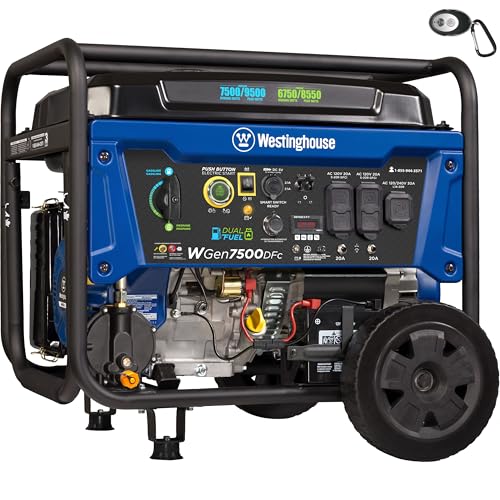

Generator Types at a Glance
Most models in this class fall into three groups. Conventional open frame units cost the least per watt and are simple to service. Inverter models run quieter and produce cleaner power for electronics, but they usually cost more at this output. Dual fuel and tri fuel models add fuel flexibility, which matters most when an outage lasts for days and gasoline becomes hard to find.
Generator Types Compared
Conventional Open Frame Models
An exposed steel frame protects the engine and alternator during transport and makes every service point easy to reach. These units are loud, often loud enough that conversation near the machine is difficult, and their power output carries more distortion than inverter output. That trade is acceptable for tools, pumps, and most home backup loads. If price per watt is your top priority and the generator will sit far from bedrooms and neighbors, this is usually the sensible starting point.
Inverter Models
Inverter technology cleans the output so sensitive electronics such as laptops, televisions, and modern furnace controls get steady voltage. Engines also adjust speed to match the load, which stretches fuel and cuts noise during light use. The limits are price and repairability, since the electronic boards cost more to replace than simple alternator parts. Shoppers comparing quieter operation across sizes should also read our guide to the best inverter generator models before deciding.
Dual Fuel and Tri Fuel Models
These models run on gasoline and propane, and tri fuel versions add natural gas where a home line is available. Propane stores for years without going stale and burns cleaner, though it delivers slightly less power than gasoline from the same engine. Natural gas removes refueling entirely during an outage, but the unit cannot move to a job site or campsite. Choose this group when fuel storage and outage length worry you more than peak output.
What to Compare in a 7500 Watt Generator
Five criteria matter most: build materials and weather resistance, size and capacity, assembly, durability, and warranty coverage. Manufacturer specifications, published safety standards, and patterns in buyer reviews, such as repeated reports of damaged shipping or hard starting, are the best sources. Use these criteria as a framework for reading the product table above.
How to Choose the Right Generator
The sections below walk through each buying factor in the order most shoppers find useful, from output and fuel down to storage and budget.
Size and Form Factor
Generator sizes step up from about 2000 watts for light duty, through 3500 and 4500 watts for partial backup, to 7500 watts, then 9500 and 12000 watts for heavier homes. A 7500 watt unit is large and heavy, typically with a tubular frame, two wheels, and folding handles, and it will not fit in a car trunk. Smaller enclosed models suit an RV or a single room, while this class assumes a garage, shed, or covered outdoor spot and enough strength or help to move it safely.
Type
Match the type to your fuel situation and your loads rather than to a label. Gasoline only models give full rated output and simple fueling, but stored gasoline needs rotation. Propane suits owners who already keep tanks for a grill or stove. Solar and standby systems solve different problems, since solar units at this output remain costly and standby units are fixed installations. Quiet and super quiet claims deserve skepticism at this size, because only inverter models in enclosures truly run at conversation level.
Features Worth Paying For
Electric start saves real effort on a cold morning, and remote start lets you start the unit from indoors once it is positioned and connected outside. A CO sensor that shuts the engine down when carbon monoxide builds up is a safety feature worth having, not an upgrade to skip. Look for a transfer switch ready outlet in 240 volt form so an electrician can connect the panel cleanly. Large wheels and a folding handle matter more than cosmetic panels, because you will move this machine over gravel, grass, and garage thresholds.
Weather Resistant Materials
A powder coated steel frame resists rust better than bare metal, and covered outlets keep driven rain and dust out of the sockets you are not using. Look for a fuel cap that seals tightly and control panels with raised covers rather than flat exposed switches. Store the generator under a ventilated cover or in a shed, since standing water and road salt attack the frame feet and wheel axles first. Materials decide how the unit ages outdoors, while placement decides whether it runs safely, a point the FAQ covers separately.
Size for Your Space
Measure the storage footprint with the handles folded and confirm the door or gate width on the path to your running spot. Plan a flat outdoor area where the exhaust points away from windows, doors, and vents, with generous clearance on every side for airflow and refueling. Never run the unit in a garage, even with the door open, because carbon monoxide collects fast in enclosed spaces. If your only outdoor spot sits close to a neighbor, noise ratings should move up your priority list.
Assembly and Anchoring
Assembly usually means attaching the wheels, support feet, and handle, then adding the supplied engine oil and fuel before the first start. Work on a level surface, check every fastener after the first hour of running, and keep the tools that came in the box with the unit. During use the generator should sit firmly on its feet so vibration does not walk it across a pad. To discourage theft during a long outage, a heavy chain through the frame to a fixed object works better than locking a wheel.
Care and Off Season Storage
Change the oil at the interval in the manual, clean or replace the air filter, and inspect the spark plug each season. For storage, either drain the fuel system or add stabilizer and run the engine long enough to pull treated fuel through the carburetor. Exercise the generator under a real load for about 20 to 30 minutes every few months, which keeps seals wet and reveals starting problems before an outage does. Store it dry, with the fuel valve closed and the battery, if fitted, kept charged.
How Much Should You Spend?
Expect to pay about $500 to $1000 for most conventional models in this class, and about $1000 to $2000 for inverter or tri fuel versions with electric start and stronger warranties. Listings under $500 that claim this output usually quote starting watts rather than running watts, so read the rating plate carefully. Spending more mainly buys quieter operation, cleaner power, longer runtime per tank, and better parts support. Budget separately for a transfer switch installation, outdoor extension cords rated for the load, and fuel storage.
Is a 7500 Watt Generator the Right Size for You?
Add up the running watts of everything you want at once, then check the starting surge of motor loads such as a refrigerator, sump pump, well pump, or furnace blower, since a motor can draw two to three times its running watts for a few seconds. A 7500 watt rating, quoted as running watts, typically covers lights, a refrigerator, a freezer, a television, a furnace blower, and one pump, but not central air conditioning or an electric range at the same time. Our detailed walkthrough on what size generator do i need shows the math load by load.
If your list fits with headroom to spare, this size avoids the strain and short runtime of a smaller unit working at its limit. Campers should note that an RV air conditioner plus a microwave can fit within this output, though a much smaller unit usually serves travel better, as our guide to the best generator for rv use explains. If your total passes this class even after dropping loads, step up a size or consider a fixed unit from our best whole house generator comparison instead of overloading a portable machine.
FAQ
What is the best 7500 watt generator for home backup?
For home backup, the strongest choice is usually the model whose outlet panel matches your connection plan, since a 240 volt 30 amp or 50 amp receptacle decides how much of the panel the generator can feed. Check also whether the neutral is bonded or floating, because transfer equipment requires the correct arrangement and an electrician must confirm it. A unit with the right outlet and neutral setup beats a slightly stronger unit that needs adapters.
What size generator do I need for a central air conditioner?
It depends on the tonnage and the starting current printed on the outdoor unit label. Many 3 ton systems surge past what a 7500 watt portable can start, even when the running draw looks manageable on paper. A soft start kit fitted by an HVAC technician lowers that surge and makes some systems reachable for this class. Without one, plan to cool with a window unit or fans during an outage and size the generator for your other loads.
How do you hook up a generator to a house safely?
The safe routes are a transfer switch or an interlock kit installed by a licensed electrician, both of which prevent power from feeding back into utility lines where line crews are working. Never plug a generator into a wall outlet, a practice that endangers workers and your own wiring. For the full sequence, permits, and inlet box placement, read our guide on how to hook up a generator to a house before you hire the work out.
How long can a generator run without stopping?
Runtime per tank at half load often falls between 8 and 12 hours, but continuous duty still needs pauses for oil checks, since many engines consume oil slowly under load. Low oil shutdown protects the engine, yet relying on it means the unit stops without warning mid outage. Refuel only after the engine cools, and plan your load schedule around one planned stop each day for oil, fuel, and a quick look at cords and outlets for heat damage.
Is it safe to run a generator in the rain?
Running in rain raises two risks, electric shock and water entering the outlets and air intake. Keep the generator on dry ground at least 20 feet from the house, and use a purpose built generator tent rated for running use if rain is unavoidable, never a tarp resting on hot parts. Keep your hands and cords dry, and route exhaust away from the home, since carbon monoxide, not rain, is the hazard that kills people during storms.
Final Thoughts
Start with your load list, then pick the type that matches your fuel supply and your tolerance for noise, and let the product table above narrow the field. The best 7500 watt generator is rarely the one with the longest feature list. It is the one you can move, store, connect, and maintain without cutting corners on safety. Prices and availability can change, so check the product page before ordering.