
Best 150 Inch Projector Screens (2026): Buying Guide
Disclosure: We may earn a commission when you buy through links on this page, at no extra cost to you. As an Amazon Associate I earn from qualifying purchases. Learn more

What to check before you buy the best 150 inch projector screen: format, gain and throw distance, and which type fits your home.
A 150 inch image changes family movie night completely, but only if the wall, the seating, and the projector can all support a screen that big. Finding the best 150 inch projector screen for your home starts with honest measuring, not with the biggest box you can order. This guide walks you through screen types, materials, gain, and throw distance so you can match the screen to your room, your routine, and your budget. The comparison table below sums up the main options at a glance.
If you are still weighing sizes or formats in general, our guide to the best projector screen covers the broader category. Here, everything stays focused on what the 150 inch size demands from a real living room, bedroom, or home office.




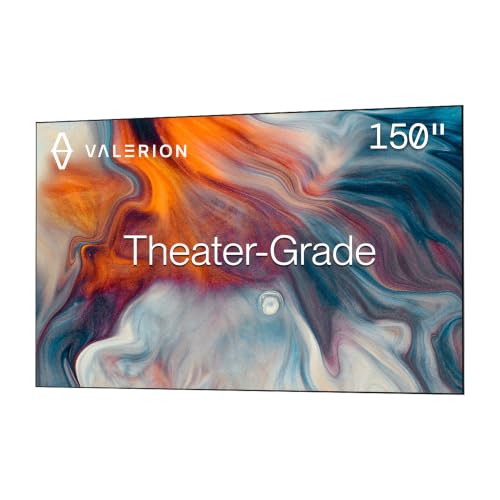
Quick Answer: The Three Routes Most Homes Take
Most buyers at this size choose between three formats. A fixed frame screen gives the flattest surface and suits a wall you can dedicate full time. A motorized screen rolls away at the touch of a button, keeping a shared living room flexible. A manual pull down or portable screen costs the least and moves between rooms, though the surface is more prone to waves.
Before You Buy: A Quick Checklist for Choosing a Projector Screen
Work through these checks in order. Size and placement come first, because no material can rescue a screen that does not fit the wall or seating layout.
Size: Match It to Your Space
A 150 inch screen in the common 16:9 format measures about 131 inches wide and 74 inches tall for the viewing area alone, and the frame adds a few inches on every side. Confirm at least about 140 inches of clear width and 82 inches of clear height, with no door swing, window, or vent crossing the space. Compare before you commit: a 120 inch screen needs about 105 inches of width, and a 135 inch screen needs about 118 inches. If your wall falls short, stepping down one size beats squeezing a frame into a tight fit.
Screen Size for Your Room and Seating Distance
Seating distance decides whether 150 inches feels immersive or overwhelming. Most viewers sit comfortably about 12 to 20 feet from a 150 inch 16:9 image, with the front row no closer than about 10 feet so your eyes are not scanning side to side during fast scenes. Throw distance matters just as much. Multiply the screen width in feet, about 10.9 feet here, by your projector throw ratio to get the lens distance. A ratio of 1.5 means the projector sits about 16 feet back, while a short throw model can sit far closer.
Which Type Fits Your Routine
Fixed frame screens stretch the material over a rigid frame, so the surface stays flat and wrinkle free for years on a dedicated wall. Motorized screens retract into a housing, which suits living rooms that host homework and guests by day. Manual pull down screens work the same way at a lower cost, though they can develop edge curl over time. Portable and tripod styles fold or roll for storage, and outdoor and inflatable styles serve backyard nights but need calm weather and a blower or stakes. Choose based on how the room gets used each week.
Screen Material and Gain for Your Lighting
Gain describes how much light the surface sends back toward the seats. Matte white material with a gain near 1.0 gives accurate color and a wide viewing angle, and it is the safe default for a room you can darken. Gray material trades a little brightness for deeper looking blacks in rooms with some ambient light. Ambient light rejecting material, often shortened to ALR, sends projector light toward the audience and pushes stray room light away, and certain versions suit ultra short throw projectors placed just below the screen. Match the material to your lighting first, then worry about smaller spec differences.
Realistic Budget Ranges
Prices at this size spread widely by format. Basic manual pull down and simple fixed frame screens often land at about $150 to $300. Tensioned motorized models and better frame builds commonly run about $300 to $800. Premium ALR material and large format specialty screens can pass $1,000. Set aside a little extra for a proper mount, a longer HDMI cable if the projector sits far back, and blackout curtains for bright windows, since those extras affect the picture as much as the screen itself.
Screen Types Compared: Three Routes at 150 Inches
Instead of ranking individual models, compare the three formats on the factors that decide daily satisfaction: surface flatness, convenience, and how the screen treats your room when idle.
Fixed Frame Screens for a Dedicated Wall
A fixed frame is the best fit when one wall can stay a screen wall. The tensioned surface stays perfectly flat, so text stays sharp edge to edge and pans look smooth. Assembly takes an afternoon of stretching and clipping the material, and two people make the job far easier at this size. The tradeoff is permanence: the screen is always visible, and moving it later means patching wall anchors. For a media room or a finished basement, that permanence is usually the point.
Motorized Screens for Shared Living Rooms
A motorized screen disappears into its housing, so the room returns to normal the moment the credits end. Look for a tensioned design at this size, because the side cords keep a large surface flat instead of letting it ripple. If this format fits your routine, see our guide to the best motorized projector screen for format specific advice. Plan around power access for the motor and a clear drop path with no shelves below the housing.
Pull Down and Portable Screens for Flexible Budgets
Manual pull down and portable designs cost the least and ask the least from your walls. A pull down mounts with two brackets and stores in its case, while freestanding portable styles set up in minutes and pack away for another room or the backyard. Our roundup of the best portable projector screen explains the portable tradeoffs in more depth. Expect slightly less flatness than a frame provides, and handle the material gently, since repeated rolling is what wears these screens out.
How We Evaluate Screens at This Size
We judge 150 inch screens on surface flatness, gain accuracy, viewing angle, frame or housing build quality, and how honestly the stated size matches the real viewing area. We weigh verified buyer reports about waves, hot spots, and motor noise alongside manufacturer specifications. Value counts too: a screen that stays flat for a decade beats a cheaper one replaced in three years.
Is a 150 Inch Projector Screen the Right Size for You?
Choose 150 inches when your main seats sit at least about 12 feet back and your wall offers the clear width measured earlier. At that distance the image fills your view the way a cinema screen does, and sports and games gain real scale. If your front seats sit closer than about 10 feet, a 120 or 135 inch screen will feel more comfortable and will look brighter from the same projector, because the light spreads over a smaller area. A modest projector that looks punchy at 120 inches can look washed out at 150 inches in a room with any ambient light. Readers building a dedicated room should also see our guide to the best projector screen for home theater.
Hanging and Placement Basics
Mount the screen so the center of the image sits near eye level for seated viewers, roughly 40 to 48 inches from the floor on a typical sofa setup, and keep the bottom edge clear of furniture. Fixed frames hang on brackets like a large picture, while ceiling mounts need anchors into joists or solid blocking at this weight. Our step by step guide on how to hang a projector screen walks through stud finding, leveling, and bracket spacing. Work with a helper for every lift, and level the housing or frame before final tightening, because a tilted screen makes keystone correction soften the image.
Common Buying Mistakes to Avoid
- Ordering before measuring the wall: the frame needs more room than the viewing area, and a screen that arrives too wide has no good fix.
- Ignoring throw distance: a projector that cannot fill 150 inches from its shelf or ceiling mount leaves you with a smaller image on a big screen.
- Pairing a dim projector with a huge image: light spreads thin at this size, so the picture looks flat even on good material.
- Skipping the tensioned option on retractable screens: large non tensioned surfaces ripple, and waves show most during slow camera pans.
- Mounting over a window or heat vent: sunlight fades material and moving air makes a hanging screen sway and shimmer.
Cost of Ownership and Care
A projector screen draws no power except for a small motor on retractable models, so running costs are close to zero. The real costs are upkeep and the occasional accessory: a replacement remote, a new mount if you move, or blackout shades for a bright room. Dust the surface with a dry microfiber cloth, and clean smudges with a barely damp cloth and no household sprays, which can strip coatings on ALR material. Keep retractable screens rolled up when not in use to protect them from dust and pets. If you would rather build your own surface, our diy projector screen guide covers paint and fabric options and their limits at large sizes.
Your Questions, Answered
How long does a projector screen last?
A fixed frame screen can serve for ten years or more, because nothing moves and the material stays under constant even tension. Retractable screens usually give shorter service, since motors, springs, and repeated rolling wear over time, and five to eight years is a fair expectation with normal use. Storing a portable screen in its case, away from heat and damp, adds years. Yellowing is the clearest sign that replacement time has come.
Can a 150 inch projector screen work in a bright living room?
Yes, with the right pairing. An ALR screen plus a bright projector keeps daytime sports watchable, though contrast will never match a dark room. Curtains on the windows facing the screen help more than any single spec upgrade. For evening movies, dimming the lights still gives the biggest improvement, so treat ALR as help for mixed use rather than a cure for a sunlit room.
What aspect ratio should a 150 inch projector screen have?
Choose 16:9 for a mixed diet of streaming, sports, and gaming, since nearly all of that content is produced in that shape. A 2.35:1 screen suits movie only rooms where most viewing is widescreen film, and it needs a projector that can fill the wider frame. A 4:3 screen only makes sense for older content or presentation use. When in doubt, 16:9 will not leave you with awkward borders on everyday viewing.
Can I use a 150 inch projector screen outdoors?
You can, if the screen is built for it. Outdoor and inflatable models use material that tolerates dew and wipes clean, and they anchor against light wind. Indoor fixed frame and motorized screens should stay inside, because moisture can stain the coating and warp a frame. Outdoors you also need darkness, since no screen at this size overcomes streetlights or a bright patio, and a calm evening gives a steadier picture.
Is a projector screen better than a painted wall?
A purpose built screen gives a smoother surface, a defined border that improves perceived contrast, and gain that a flat wall cannot match. A painted wall costs less and works acceptably in a dark room, especially with specialty screen paint. The gap shows most with 4K content, where wall texture softens fine detail. If budget forces a choice today, paint now and add a screen later.
Final Thoughts
The right choice comes down to your wall, your seats, and how your room gets used between movies. Measure honestly, match the material to your lighting, and pick the format that fits your routine, and the best 150 inch projector screen for your home becomes an easy call. Compare your finalists against the product table above, and confirm the frame dimensions once more against your wall.


