
Best Egg Poachers: Our 2026 Checklist and Top 3 Picks
Disclosure: We may earn a commission when you buy through links on this page, at no extra cost to you. As an Amazon Associate I earn from qualifying purchases. Learn more

The best egg poachers from Eggssentials and Sistema, with a buyer checklist, red flags and poaching tips.
A perfectly poached egg, with a set white and a warm, runny yolk, is the star of eggs Benedict and avocado toast, but the classic swirling water method frustrates plenty of home cooks. Egg poachers take the guesswork out, whether you choose a stovetop pan with cups, silicone pods, a microwave cooker or an electric egg cooker with a poaching tray. This guide to the best egg poachers lays out the checklist we use to judge them, then names three picks that pass.
We explain each criterion, share our picks, add a quick buyer checklist, red flags, care tips and common questions. Cook eggs until whites are firm; the USDA advises that young children, pregnant people, older adults and anyone with a weakened immune system eat eggs fully cooked or choose pasteurized eggs for runny yolks. Lift lids away from your face to avoid steam burns, and pierce yolks before microwaving so they do not burst.


How We Evaluate the Best Egg Poachers
We score each poacher on cooking method and capacity, consistency, nonstick release, materials, ease of use, cleaning and value. Here is what good and poor look like.
Intended Use and Who It's For
Families who make brunch for several people need a 4 to 6 cup stovetop pan, like Eggssentials' or Modern Innovations' poacher pans. Singles and office workers do well with microwave cookers, like Sistema's Easy Eggs, or silicone pods. Busy households who want boiled, poached and omelet options in one gadget may prefer an electric egg cooker, like Dash's Rapid Egg Cooker or Hamilton Beach's 6 in 1.
Good: a poacher sized for how many eggs you usually make. Poor: a single cup gadget for a family of five.
Key Performance Specs
Cup size and count matter most. Eggssentials and RUNZI list 75 ml cups that hold extra large and jumbo eggs, while Modern Innovations' four cups each hold one large egg. Electric cookers vary: Dash cooks up to 7 boiled eggs and includes a poaching tray, evoloop handles 6 eggs with two poaching trays and Hamilton Beach poaches up to 4 eggs in about 10 minutes.
Build Quality and Materials
Heavy stainless pans heat evenly and last. Eggssentials and RUNZI use heavy stainless steel bodies with 3 ply aluminum encapsulated bases that work on all stoves including induction. Modern Innovations uses an 8 inch 18/8 stainless pan, and NutriChef uses 304 stainless steel. Silicone pods, like Eggssentials' BPA free cups and COZILIFE's cups rated from minus 40°F to 405°F, flex to release eggs.
Nonstick Release and Coatings
Eggs stick fast without a good coating. Eggssentials and RUNZI list PFOA free nonstick cups, Modern Innovations uses Teflon coated cups and Hamilton Beach lists a PFAS free nonstick skillet. Silicone releases well when lightly sprayed with oil. Avoid metal utensils on coated cups; most pans include a silicone spatula.
Ease of Use and Setup
Glass lids let you watch eggs set. Eggssentials, Modern Innovations, RUNZI and NutriChef include tempered glass lids, and NutriChef adds a timer and oven mitt. Electric cookers simplify timing: Dash uses a thermal sensor that shuts off and chimes when water evaporates, and evoloop sounds a ready buzzer.
Safety and Certifications
Look for BPA free plastics and silicone and stay cool handles. Sistema says its cooker is phthalate and BPA free with a steam release vent, Eggssentials' pan has a Bakelite handle that stays cool and Modern Innovations has a stay cool handle. Auto shut off, like Dash's, prevents boiling dry.
Price vs Value
Silicone pods cost around $11 to $13, microwave cookers around $17 to $26, electric egg cookers around $20 to $45 and stainless poacher pans around $31 to $48. Pans that double as sauté pans when you remove the insert, like Eggssentials', Modern Innovations' and RUNZI's, add value.
Stovetop vs Microwave vs Electric
Stovetop poacher pans give the most control and the classic look, but you need to watch the heat. Microwave cookers like Sistema's are fastest for one or two eggs, though power levels vary and timing takes practice. Electric cookers like Dash's, evoloop's and Hamilton Beach's are the most hands off: add water, set eggs in the tray and wait for the chime or buzzer. Many households use an electric cooker on weekdays and a stovetop pan for weekend brunch.
3 Picks That Pass Our Checklist
Our picks are the Eggssentials Egg Poacher Pan as the best overall, the Eggssentials Silicone Poached Egg Cups as the best value and the Sistema Easy Eggs Microwave Egg Cooker as the best compact pick.
We compared capacity, cup size, materials, nonstick coating, lid, handle, cleaning and price, along with the overall pattern in owner feedback. We did not cook with these poachers ourselves; the notes reflect maker specifications.
Best Overall: Eggssentials Egg Poacher Pan
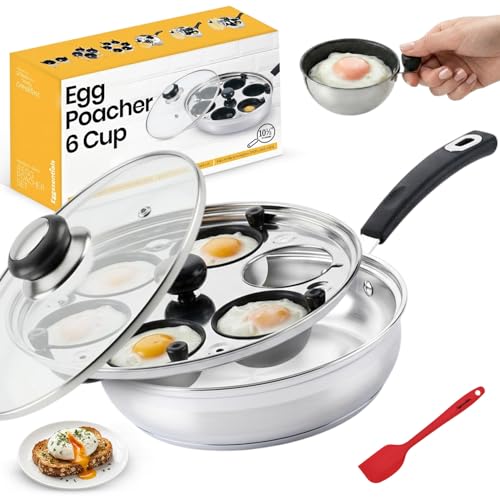
The Eggssentials poacher pan suits families and brunch hosts who want restaurant style poached eggs on the stovetop, at around $48. Eggssentials lists a heavy stainless steel body for all stoves including induction, a 3 ply aluminum encapsulated base, PFOA free nonstick cups of 75 ml that hold extra large and jumbo eggs, a cool touch Bakelite handle, a tempered glass lid and an included spatula. Remove the insert and the pan works as a sauté pan.
Two strengths stand out: induction compatible construction and large cups for big eggs. It also has one of the largest owner review counts among egg poachers.
The limitation is a higher price than simple pods or microwave cookers.

Best Value: Eggssentials Silicone Poached Egg Cups
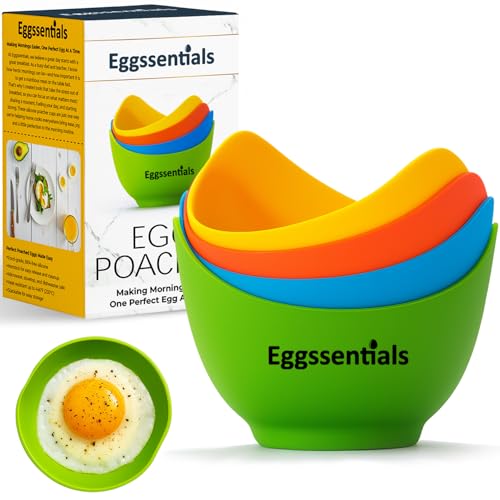
The Eggssentials silicone cups suit budget cooks, campers and anyone who wants to poach eggs in a pan they already own, at around $13 for four. Eggssentials lists BPA free food grade silicone cups that flex for easy egg removal, cooking in about 30 seconds in the microwave or 5 to 7 minutes on the stovetop, use in an Instant Pot, dishwasher safe cleanup and a stackable design.
Its strengths are a very low price and flexibility across microwave, stovetop and pressure cooker.
The trade off is that eggs cooked in pods hold a rounded shape rather than a classic free form poach.

Best Compact Pick: Sistema Easy Eggs Microwave Egg Cooker
The Sistema Easy Eggs cooker suits office workers, students and small kitchens, at around $17. Sistema lists a 270 ml microwave cooker for poached and scrambled eggs and mini omelettes, a steam release vent for splatter free heating, side tabs for carrying, dimensions of about 125 by 137 by 67 mm and dishwasher (top rack), fridge and freezer safe care. It is BPA and phthalate free and designed and made in New Zealand.
The appeal is fast, mess free eggs with almost no cleanup.
The limitation is small capacity, and microwave timing takes a few tries to perfect.

Quick Buyer Checklist
How many eggs do you usually poach? Choose 1 to 2 cups for one person, 4 to 6 for families.
Which cooking method fits? Stovetop, microwave, silicone pods or electric.
Do you have an induction cooktop? Pick a magnetic stainless base.
Are cups nonstick or silicone? Both release eggs better than bare metal.
Is there a glass lid? Watching helps you get the yolk right.
Is it dishwasher safe? Check every part.
Red Flags to Watch For
Thin aluminum pans. They warp and heat unevenly.
Plastic cups on the stovetop. They can melt.
No mention of BPA free materials. Look for food grade silicone and plastics.
Tiny cups. Large eggs overflow small cups.
Missing lids. Poaching needs trapped steam.
Setup and Care Tips
Grease cups lightly. A little oil or butter helps release.
Bring water to a gentle simmer. Hard boiling can splash and overcook eggs.
Use a silicone spatula. Protect nonstick coatings.
Wash soon after cooking. Dried egg is harder to remove.
Descale electric cookers. Vinegar removes mineral buildup.
Egg Poachers: Your Questions Answered
How do I maintain an egg poacher?
Wash cups and pans with warm soapy water or in the dishwasher if allowed, and dry fully. Avoid metal utensils and abrasive pads on nonstick cups. For electric cookers, wipe the heating plate and remove mineral buildup with diluted vinegar.
How long does an egg poacher last?
A stainless poacher pan can last many years; nonstick cups may wear in a few years with heavy use. Silicone pods last years if kept away from sharp tools. Electric egg cookers usually last several years with regular descaling.
How much should I spend on an egg poacher?
Most people spend around $13 to $48. Around $13 buys silicone pods, around $17 to $26 a microwave cooker, around $20 to $45 an electric egg cooker and around $31 to $48 a stainless poacher pan.
Are expensive egg poachers worth it?
Expensive poacher pans are worth it if you poach eggs often or for a crowd. Heavy stainless pans like Eggssentials' heat evenly, work on induction and double as sauté pans. For occasional poached eggs, silicone pods or a microwave cooker work well.
What features matter most when buying egg poachers?
Capacity, cup size, nonstick release and a glass lid matter most. Choose a stainless base for durability and induction, nonstick or silicone cups for easy release and a size that matches how many eggs you cook at once.
How long does it take to poach an egg in a poacher?
Most stovetop poacher pans cook eggs in about 3 to 6 minutes once the water simmers, depending on how firm you like the yolk. Eggssentials says its silicone cups take 5 to 7 minutes on the stovetop or about 30 seconds in the microwave, and Hamilton Beach poaches 4 eggs in about 10 minutes including heat up.
Final Thoughts
The best egg poachers cook eggs evenly, release them cleanly and fit how many you make. Eggssentials' stainless poacher pan is the best overall, Eggssentials' silicone cups are the best value and Sistema's Easy Eggs microwave cooker is the best compact pick.
For more kitchen guides, see the best omelet pans, the best nonstick cookware sets, the best nonstick crepe pan and the best breakfast bar. Then compare current prices in the product table above.


