
Best Collapsible Dish Drying Rack: Buyer's Guide for 2026
Disclosure: We may earn a commission when you buy through links on this page, at no extra cost to you. As an Amazon Associate I earn from qualifying purchases. Learn more

Compare the best collapsible dish drying rack by styles, drainage, folded size and materials.
After dinner in a busy family kitchen, the counter can disappear under plates, pans, and lunch boxes, yet by morning that same rack is just taking up room you need for coffee and meal prep. Choosing the best collapsible dish drying rack solves both halves of that problem, because it opens wide when dishes are wet and folds away when the counter has other jobs.
This guide walks through sizes, types, materials, and budgets so you can match a rack to your routine instead of guessing from a photo. Start with the comparison table below, then use the checklist that follows. If you have counter room to spare and never plan to store the rack, see our guide to the best dish drying rack for fixed models instead.


Quick Answer: Three Routes in 30 Seconds
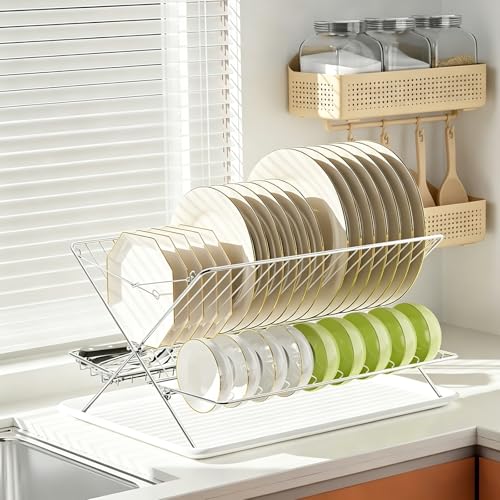
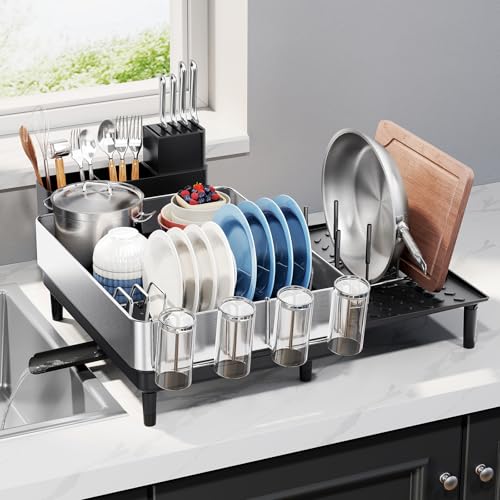
Most shoppers end up with one of three routes. A folding frame rack gives you the most capacity and stability for daily family use. A soft silicone rack folds the flattest and suits small counters, dorms, and RV storage. A roll up rack rests over the sink and drains straight down, and our guide to the best in sink dish drying rack covers that approach in more depth.
- Daily family loads: choose a folding frame with a drainboard and utensil holder.
- Tiny counters and travel: choose a soft silicone style that rolls or folds into a drawer.
- No counter to give: choose a roll up style that works over the sink and stores in a cabinet.
Before You Buy: A Quick Checklist for Choosing a Dish Drying Rack
Size: Match It to Your Space
Measure two footprints before you shop, not one. First, measure the open rack on your counter and leave a little room on each side so pan handles do not knock it. Second, measure the folded rack against the drawer or cabinet where it will actually live, because a rack that folds flat on paper still needs a real storage spot. Small sizes suit one or two people, while large and two tier layouts suit families, and homes that cook big meals often do better with the best large dish drying rack in a fixed format.
Which Type Fits Your Routine
Think about how the rack moves through your day. A folding frame opens in seconds and feels closest to a fixed rack, so it suits households that wash dishes after most meals. A soft silicone rack pops up for a load and then flattens, which suits occasional use and kitchens where the rack shares space with a cutting board and a coffee maker. A roll up or in sink style skips the counter entirely and drains into the basin, which helps when counter depth is the real problem. Match the type to the routine you already have.
Features Worth Paying For, and Ones to Skip
A few features earn their cost every day. A drainboard with a slight slope moves water toward the sink instead of pooling under glasses, a spout you can swing toward the basin keeps that flow off the counter, and a removable utensil holder keeps wet forks from dripping across the rack. Cup holders along the side help if your household goes through many mugs and bottles. You can usually skip a second tier on a small rack, since it adds wobble without adding much usable room, and skip decorative finishes that chip and then hold moisture in the scratches.
Materials and Food Contact Safety
Most collapsible racks use silicone, plastic, or coated steel, and each behaves differently over time. Silicone flexes without cracking, plastic frames stay light and low in cost, and steel frames feel the most rigid under heavy pots. Look for plastic and silicone described as food grade and BPA free, since cups and utensils rest on these surfaces while they dry. If you prefer metal and plan to leave the rack out full time, our guide to the best stainless steel dish drying rack explains how that material handles daily water exposure.
Realistic Budget Ranges
Prices stay modest for this category, and the tiers mostly buy sturdiness and capacity. Basic soft silicone racks often cost under $20 and suit light, occasional loads. The middle band, about $20 to $30, usually brings a firmer frame, a drainboard, and a utensil holder that stays put. Larger folding and two tier designs often land at about $30 to $50, a step up that makes sense for families who load the rack twice a day. Spending beyond that tends to buy heavier steel construction rather than extra room.
Types Compared: Three Collapsible Styles and How They Differ
Comparing styles is the most reliable way to shop this category. Each style below trades capacity, stability, and storage size in a different way.
Folding Frame Racks for Daily Family Use
A folding frame rack opens into a rigid shape with raised slots for plates and a flat area for bowls and pans. Choose this style if you cook most nights and want the rack to feel steady when a heavy skillet lands on it. The trade off is storage bulk, because even folded, a frame keeps some thickness and needs a wider cabinet. Check that the hinges feel firm when open, since a frame that flexes at the joints will rock every time you add a plate.
Soft Silicone Racks for Tight Storage
A soft silicone rack uses flexible walls that pop up to form a shallow basin with slots or ribs for dishes. It folds or rolls to a fraction of its open size, so it can live in a slim drawer or travel to a rental home. Capacity is the limit here, because the soft walls hold fewer plates upright and heavy pots can bow the sides outward. This style works best for a couple of place settings at a time, rather than a full holiday cleanup.
Roll Up Racks That Work Over the Sink
A roll up rack is a grid of rods joined by silicone edges, and you unroll it across the sink so dishes drain straight into the basin. It stores as a tight roll, doubles as a surface for rinsing produce, and keeps water off the counter. Before you buy, measure your sink width carefully, because the rods need solid support on both rims and a rack that is too short will sag or slip. This style holds plates and pans well but offers little help for utensils.
Our Selection Process for the Best Collapsible Dish Drying Racks
We judge collapsible racks on five criteria: how flat and how small they fold, how much a full meal load they hold without tipping, how well water drains toward the sink, how simple they are to clean, and whether the price fits the build quality. Our comparisons draw on maker specifications and on patterns in verified buyer feedback, such as repeated comments about hinge wear or pooling water.
Collapsible Compared With Other Dish Drying Racks: What Works and What Does Not
The clear strength of a collapsible rack is control over your counter. You gain a full drying station at cleanup time and a clear work surface the rest of the day, which matters in apartments and small homes. Folding also makes the rack easy to take to a vacation rental, a dorm, or an RV, and easy to store during a deep clean or a move.
The honest limits are capacity and moving parts. A fixed rack of the same footprint usually holds more, because its walls and tiers never need to fold, and hinges are the first places a collapsible rack wears out. If your household runs the rack hard three times a day and never needs the counter space back, a fixed rack may serve you better. If you value the space more than the last bit of capacity, collapsible is the right trade.
Common Buying Mistakes to Avoid
- Buying by open size alone, so the folded rack fits nowhere and ends up living on the counter anyway.
- Skipping the sink measurement for a roll up style, so the rods rest on one rim only and slide under a heavy pan.
- Choosing the cheapest thin silicone, so the walls bow outward and plates slump together and stay wet.
- Ignoring drainage direction, so water runs off the drainboard onto the counter instead of into the sink.
- Paying for extra tiers and holders your household never uses, so cleanup takes longer to load and unload.
Cost of Ownership and Care
Ownership costs stay low, since a collapsible rack uses no power and needs no filters or refills. The parts that wear are small ones, such as a drainboard that warps or a utensil holder that cracks, and on many designs those pieces can be replaced on their own. A rack that costs a little more up front often works out cheaper than replacing a flimsy one each year.
Care is mostly about keeping joints and surfaces dry between uses. Shake off standing water, let the open rack air out before you fold it away, and store it dry so moisture is not sealed against the hinges or silicone. Wipe the drainboard often, since a thin film builds up where water sits. For a full routine, read our walkthrough on how to clean a dish drying rack before buildup becomes hard to shift.
FAQ: Your Questions, Answered
Can a collapsible dish drying rack go in the dishwasher?
Many silicone parts and some plastic drainboards and utensil holders are dishwasher safe, but full folding frames usually are not, because hinges and coated joints can trap water and detergent. Check the care notes for each part rather than the rack as a whole. If you do wash parts in the dishwasher, place them on the top rack, and let hinges dry fully open afterward so no moisture stays sealed inside the joint.
Is a dish drying rack worth it for a small kitchen?
Yes, in a small kitchen a rack earns its place by keeping wet dishes in one defined zone instead of spread across towels and every spare inch of counter. The collapsible format adds the key benefit that the zone disappears when you need to cook. To make it work, pick a rack that drains toward the sink, since a small kitchen has no spare counter to forgive puddles.
How long does a collapsible dish drying rack last?
Most collapsible racks last about two to five years in daily use, and the spread depends more on the moving parts than on the tray or basin. Silicone styles often age the most gracefully because there is little to crack, while frame hinges loosen over time. You can stretch that lifespan by folding the rack gently instead of forcing it flat, and by replacing a worn utensil holder rather than the whole rack when the rest still works well.
Are collapsible dish drying racks worth it for RV and dorm living?
For RV and dorm living they are often the most practical option, because storage space is measured in inches and a fixed rack has nowhere to go between meals. A soft silicone or roll up style can ride in a drawer and come out only at cleanup. One point guides rarely mention is movement in transit, so store the rack where it cannot slide and rattle, and choose a style with no loose small parts that can vanish in a shared kitchen.
Can a collapsible dish drying rack hold heavy pots and cast iron pans?
A firm folding frame can hold a heavy pot or a cast iron pan if you place it low and centered, where the frame has the most support. Soft silicone walls are the weak point, since a pan that leans against them can push them outward and let nearby plates tip. A practical approach is to dry one heavy pan on the rack and hand dry cast iron right away, which also protects its seasoned surface from sitting in water.
Final Thoughts
The right rack fits your counter when it is open, fits your storage when it is folded, and matches the loads you actually wash. Frame styles suit daily family cooking, silicone styles suit tight storage and travel, and roll up styles suit sinks with no counter to spare. Use the product table above to compare the styles, and let that fit guide your choice of the best collapsible dish drying rack for your home.


