Best Budget Binoculars for Astronomy: A Practical Buying Guide for 2026
Disclosure: We may earn a commission when you buy through links on this page, at no extra cost to you. As an Amazon Associate I earn from qualifying purchases. Learn more

Compare budget binoculars for astronomy by aperture, exit pupil, coatings and tripod options, with a checklist for choosing a first pair for the night sky.
A clear night can feel wasted when star clusters blur into faint smudges through a small or shaky pair of binoculars. The best budget binoculars for astronomy fix that without telescope money, because a wide and bright view is the easiest way to learn the sky. This guide shows you which sizes gather light, which corners a low price cuts, and how to match a pair to your eyes before you use the comparison table below.
You do not need high magnification to enjoy the Moon, the Pleiades or the Orion Nebula. You need enough aperture to make faint objects visible, clean optics that keep contrast, and a size you can hold steady long enough to look properly.


Who Should Buy Budget Astronomy Binoculars?
These binoculars suit people who want night sky views, while keeping money aside for a tripod adapter or a chair.
First Time Stargazers Learning the Constellations
If you are still learning to find your way around the sky, start with moderate power that is easy to aim. A 7x50 or 10x50 gives a wide field, so objects stay in view while you move from a chart to the sky and back. That width matters more than extra power at this stage, because losing an object every few seconds teaches frustration instead of star patterns. Start with the Moon and bright clusters.
Backyard Observers Under Suburban Light Pollution
If most of your observing happens from a yard or balcony with streetlights nearby, aperture and contrast should lead your choice. A 10x50 darkens the background sky a little more than a 7x50 at the same aperture, which helps clusters stand out, and good coatings protect what contrast you have. Set expectations around the Moon, planets, double stars and the brighter deep sky objects.
Campers and Travelers Who Also Watch Wildlife by Day
If your binoculars earn pack space by working in daylight too, an 8x42 or 10x42 is a sensible compromise, even though the smaller objective gathers less light at night. By day the same pair can follow birds, and if that side matters to you, see our guide to the best budget binoculars for birding for daylight advice. At night, use the darkest stop on your route.
Key Features to Compare
Six checks separate a bright and comfortable astronomy pair from a cheap pair that looks similar in photos.
Aperture and Objective Lens Size for Gathering Light
Aperture is the diameter of the front lenses, written as the second number in a size such as 10x50, where 50 means 50 mm. Bigger front lenses collect more light, so faint stars, nebulae and galaxies become easier to see. For astronomy on a budget, 50 mm is the sweet spot, because it gathers far more light than a 42 mm lens while the binoculars stay light enough to hold.
Magnification and Exit Pupil for a Bright Image
Magnification is the first number in the size, and dividing aperture by magnification gives the exit pupil, the width of the light beam reaching your eye. A 7x50 gives about 7 mm and a 10x50 gives about 5 mm, and both can look bright at night. Higher power also magnifies hand shake, so stay at 7x or 10x for handheld use and treat anything above 12x as a tripod purchase.
Prism Type and Lens Coatings for Contrast
At budget prices, Porro prism binoculars usually give more brightness for your money than roof prism models, because roof prisms need costly coatings to match them. Look for BaK 4 prism glass, which produces a round and evenly lit exit pupil, rather than BK 7. Choose fully multi coated optics when you can, since coatings on all air to glass surfaces cut reflections that wash out faint objects.
Field of View, Eye Relief and Eyecups
Field of view tells you how much sky fits in the eyepieces at once, and a wider field makes finding and following objects far easier. A 7x50 often shows about 6 to 7 degrees, enough to hold the whole Pleiades cluster with room around it. Eye relief is the distance your eye can sit from the eyepiece and still see the full field, and glasses wearers should look for about 17 to 20 mm.
Weight, Focus, Collimation and Tripod Mounting
A typical 10x50 weighs about 25 to 35 ounces, and that weight steadies small hand movements at first, then tires your arms after a few minutes of looking up. A smooth center focus wheel and a right eye diopter let you match both eyes precisely, with no grit or loose play. Check collimation on arrival by viewing a distant straight edge, because misaligned optics cause eye strain and doubled images. Most 50 mm models also accept a tripod adapter through a threaded socket under the front cap.
Weather Sealing and Resistance to Dew and Fog
Astronomy is hard on optics, because a warm house and a cold night sky meet on your lenses as dew. Sealed binoculars filled with nitrogen resist internal fog when temperatures change, and that protection matters more for this hobby than rain resistance does for daytime users. External surfaces can still dew over during long sessions.
Binocular Sizes and Types for Night Sky Viewing
On a tight budget, the best budget binoculars for astronomy are usually the ones whose support needs you can honestly meet. Our wider guide to the best budget binoculars helps if you weigh general use models against astronomy first ones.
The 7x50 and 10x50 All Rounders
These sizes are the default starting point, and the choice comes down to steadiness and sky brightness. Pick 7x50 if your hands are not steady, if you observe under dark rural skies, or if you want the widest view for sweeping the Milky Way. Pick 10x50 if your skies carry light pollution and you can brace your elbows or lean back in a chair.
15x70 Giant Binoculars for Mounted Viewing
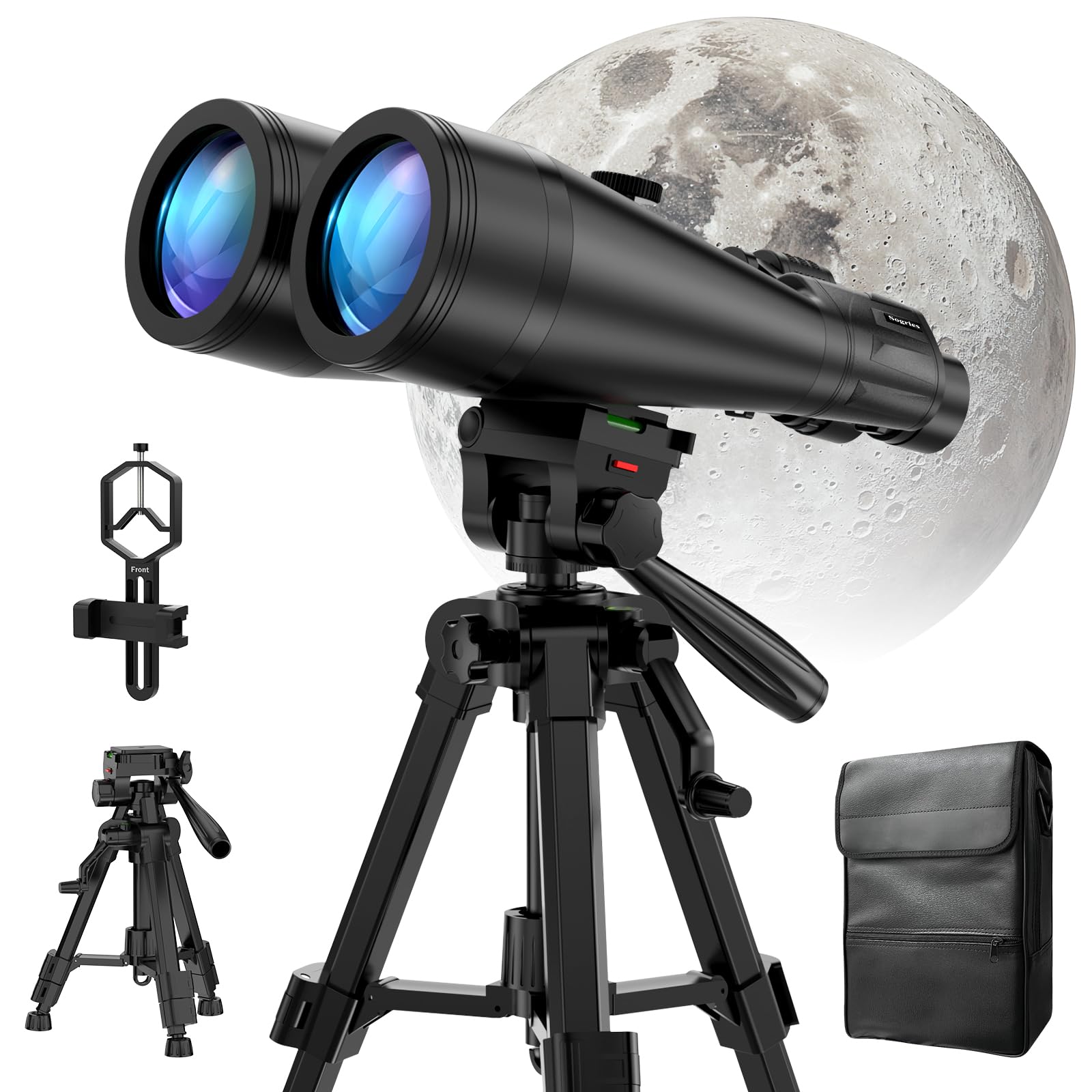
A 15x70 gathers much more light and shows fainter objects. At about 50 ounces and 15x power, hand shake ruins the view within seconds, so budget for a tripod or mount along with the binoculars. The reward is real at dark sites, where nebulae gain shape. If you later compare larger options, see our guide to the best binoculars astronomy for the broader category.
Small Compact Binoculars as a Travel Compromise
Compact models with objectives of 32 mm or less fit a jacket pocket. At night they gather too little light for faint objects, so they suit casual Moon viewing rather than deep sky work. If portability decides the purchase, see our guide to the best budget compact binoculars.
Common Mistakes to Avoid
- Choosing the highest magnification on the shelf, because shake then blurs the extra detail the power promised.
- Buying objectives under 42 mm for deep sky use, because too little light reaches your eyes to show faint objects.
- Ignoring coatings and prism glass to save a few dollars, because lost contrast hides the targets you bought the pair to see.
- Skipping the collimation check during the return window, because misaligned optics cause eye strain that gets blamed on your eyes.
- Buying a 15x70 without a tripod or mount, because the view shakes too much to use at that power.
- Judging brightness in a bright store, because shop lighting hides the dim image a cheap pair shows at night.
Care and Maintenance for Astronomy Binoculars
Gentle habits protect the coatings your views depend on. Blow loose grit off the lenses first, then wipe with a clean lens cloth in small circles, because rubbing dry dust across a coated surface can scratch it. Let a dewed pair dry indoors with the caps off before storing it, because sealing in moisture invites fungus.
Store your binoculars in a dry and padded bag at room temperature, away from car trunks that swing between heat and cold. Check the strap, hinge tension and focus wheel a few times a year.
FAQ
What features matter most in budget binoculars for astronomy?
Aperture, coatings and steadiness matter most. A 50 mm objective with fully multi coated optics shows more than a larger but poorly coated pair, and a size you can hold still beats extra magnification. One extra check helps at this price: look at a bright ceiling and confirm the exit pupils look round and evenly lit.
Which budget binocular size is better for low light astronomy, 7x50 or 10x50?
Both sizes can work, and the better choice depends on your sky and your hands. The 7x50 gives a brighter and wider view for dark sites, while the 10x50 shows a darker background that suits suburbs. Try observing seated with your elbows on your knees, because that posture closes much of the steadiness gap.
What do the numbers 10x50 mean on astronomy binoculars?
The numbers mean the binoculars magnify the view 10 times and each front lens measures 50 mm across. The pairing also tells you the character of the view, since dividing the second number by the first gives the exit pupil described earlier. Use these numbers plus the field figure to compare models quickly when prices look alike.
Can a smartphone replace budget binoculars for astronomy?
No, a smartphone cannot replace binoculars for most night sky viewing. Phone cameras can stack exposures and produce striking photos, but a phone gives you a small, delayed and narrow view that skips the sense of standing under the sky. Binoculars show both eyes a live and wide field at once. A phone still helps for star charts.
How much should you spend on your first budget binoculars for astronomy?
Spending about $75 to $200 puts you in the range where 50 mm optics, decent coatings and sound alignment come together. Below about $50, samples vary widely and returns matter as much as specs. Reserve part of the budget for a tripod adapter and a reclining chair, because comfort reveals more than a small step up in glass.
Final Thoughts
Start with aperture you can support, coatings you can verify and a size your hands can hold steady. A 10x50 suits most first buyers, a 7x50 rewards dark skies and a 15x70 pays off once a mount joins the budget. Whichever route you take, the best budget binoculars for astronomy are the pair that gets you outside often, so compare your shortlist in the product table above.