
Best Budget Astronomy Binoculars Made Simple: A Clear Buying Guide for 2026
Disclosure: We may earn a commission when you buy through links on this page, at no extra cost to you. As an Amazon Associate I earn from qualifying purchases. Learn more

Shopping for the best budget astronomy binoculars for the first time? Learn the terms, compare options, and avoid rookie mistakes with this easy guide.
Buying your first pair for the night sky should feel exciting, not confusing. The best budget astronomy binoculars gather far more light than your eyes alone, so the Moon shows craters, Jupiter reveals moons, and faint star clusters become visible from a backyard. This guide explains the few numbers that matter before you spend anything.
You do not need expert knowledge or a large budget to begin. You need the right balance of lens size, magnification, comfort, and steadiness. Note the features that fit your eyes and your sky, then use the comparison table below to match those needs to a price you can accept.


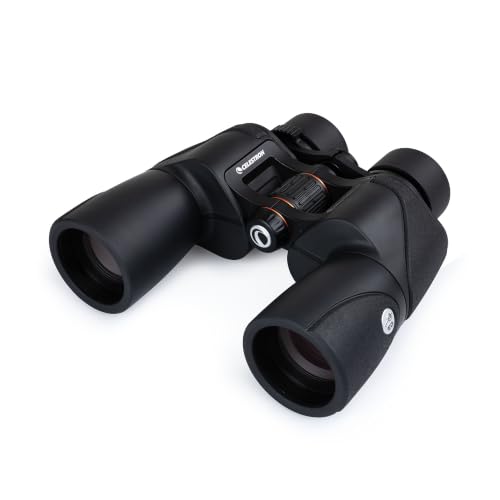
Astronomy Binoculars 101: The Basics for New Observers
Binoculars are simply two small telescopes side by side, one for each eye. Each large front lens, called the objective lens, collects light and sends it through glass prisms that flip the image upright, then through the eyepieces. Using both eyes feels natural, and the wide view makes objects easy to find without a mount.
Two numbers printed on every model tell you most of the story, magnification and objective lens diameter in millimeters. Once those basics feel clear, see our guide to the best binoculars astronomy for larger and pricier options beyond a starter budget.
Who Should Buy Astronomy Binoculars on a Starter Budget
A modest pair suits more people than expected, because many favorite sky targets are large and bright.
New Observers Learning the Night Sky from a Backyard
If you are still learning constellation shapes, a wide and forgiving view helps more than high power. You can sweep along the Milky Way, check your place against a chart, and find targets without losing them after every small movement. A simple center focus wheel keeps your first sessions focused on the sky itself.
Viewers Who Love Wide Views of Star Clusters and Nebulas
Some targets reward breadth rather than detail. The Pleiades, the Double Cluster, and the Orion Nebula all look best framed with dark sky around them, and binoculars deliver exactly that framing. If your joy comes from rich star fields, choose moderate magnification and spend your budget on larger, well coated lenses instead.
Families and Friends Who Will Share One Pair
Shared observing means constant small adjustments. Look for a wide range of interpupillary distance, the spacing between the eyepieces, so adults and older children can see one round field instead of two overlapping circles. Twist up eyecups and a clear diopter dial let each person reset the fit in seconds.
Key Features to Compare
Six factors decide how the best budget astronomy binoculars perform after dark. Readers also weighing general daytime models can see our guide to the best budget binoculars and notice how different the priorities become once the sun goes down.
Power and Lens Size: The 7x50 and 10x50 Balance
Magnification makes objects look closer, while the objective lens decides how much light you have to work with. For handheld astronomy, about 7 to 10 times magnification paired with 50 mm lenses is the classic budget balance, steady enough to hold and bright enough for clusters and the Moon. Larger 70 mm or 80 mm lenses show fainter objects, but they add weight and usually need support. Chasing power alone is a trap, because extra magnification also magnifies the shake in your hands.
Exit Pupil and Brightness After Dark
Exit pupil is the width of the light beam that reaches your eye, found by dividing lens size by magnification. A 10 by 50 pair gives a 5 mm exit pupil, a comfortable match for most adults at night. Younger eyes in dark places can use a larger exit pupil, near 7 mm from a 7 by 50 pair. If the exit pupil is very small, the image looks dim even when the lenses are large.
Prism Glass and Lens Coatings
Prisms fold the light path inside the body, and their glass quality shapes contrast. BaK 4 glass is the budget standard worth insisting on, because it passes light more cleanly than cheaper BK 7 glass, which can gray the edges of the field. Fully multi coated optics cut reflections and keep faint stars from washing out. At this price, good coatings on modest lenses often beat bare lenses of a larger size.
Eye Relief, Focus Wheel and Diopter Fit
Eye relief is the distance your eye can sit from the eyepiece while still seeing the full field. If you wear glasses, look for about 17 mm or more. The center focus wheel should turn smoothly with one finger, even with gloves on. A diopter dial lets you correct for differences between your two eyes once, after which the center wheel focuses both sides together.
Weight, Balance and Tripod Support
A pair that feels fine for two minutes can tire your arms after twenty. Most 50 mm models weigh about 1.5 to 2.5 pounds, manageable in short sessions with rests between targets. Heavier pairs shine on a tripod, so check for a threaded socket under a small cap between the front hinges, that accepts a standard tripod adapter. Compact models are lighter for travel, and our guide to the best budget compact binoculars covers that trade, but their small lenses gather too little light for sky use.
Sealing Against Dew and Internal Fog
Night air is damp air, and lenses cool quickly once the sun sets. Sealed bodies filled with dry nitrogen resist internal fog, which forms on inside surfaces where you cannot wipe it away. Rubber armor gives a surer grip when dew makes everything slick. Waterproof here means the pair survives dew and light drizzle, not a downpour.
Getting Started: Setup and First Use on Your First Night
Unbox the pair in daylight and learn the controls while you can see them. Set the interpupillary distance until the view merges into one circle. Then cover the right lens, focus a distant object with the center wheel, cover the left lens instead, and set the diopter dial for your right eye.
Start with the Moon, then try a bright cluster such as the Pleiades. Brace your elbows on a chair back or your knees, since support steadies the view more than any grip trick. Let your eyes adapt to darkness for about 20 to 30 minutes and avoid bright phone light.
Common Mistakes to Avoid
- Choosing the highest magnification leaves you with a dim, shaky image you cannot hold still enough to enjoy.
- Buying tiny compact lenses starves the view of light, so faint clusters and nebulas nearly vanish.
- Ignoring eye relief means glasses wearers lose the outer field and see only a narrow tunnel of sky.
- Skipping the tripod socket on a heavy 70 mm pair turns every session into an arm workout that ends early.
- Judging a pair indoors under bright lights hides the weak contrast and dim edges that show up at night.
- Storing binoculars in a damp garage invites internal fog and mold that no surface cleaning can remove.
Care and Maintenance for Astronomy Binoculars
Blow loose grit off the lenses first, then wipe gently with a clean microfiber lens cloth in slow circles, never with a shirt, which drags grit across the coating. Leave the caps on when the pair is not at your eyes, and let a dewy pair dry uncovered at room temperature before you close the case.
Store the pair in a dry room, and never open the body to clean inside, because the sealed nitrogen fill and tube alignment are set at the factory. If the two sides ever show a doubled image after a drop, that is a job for a repair service, not a home fix.
Astronomy Binoculars: Your Questions Answered
What specs matter most for beginners buying astronomy binoculars on a budget?
Objective lens size, exit pupil, and coatings matter most. Start with 50 mm lenses and an exit pupil near 5 mm, then confirm BaK 4 prisms and fully multi coated glass. One point many buyers miss is field of view, listed in degrees. A field near 6 degrees or wider makes finding targets far easier, because you can fit a whole constellation pattern in view while you check your chart.
Which astronomy binoculars are better for low light viewing?
Pairs with larger lenses and lower magnification are better for low light viewing. A 7 by 50 model sends a wider beam of light to your eye than a 15 by 70 model, and that wider beam looks brighter against a dark sky. Dark surroundings help just as much as hardware, so a modest pair at a rural site will outperform a costly pair under bright streetlights.
Is a smartphone enough instead of astronomy binoculars for stargazing?
No, a smartphone is not enough for most stargazing. Phone cameras brighten photos with software, but the live screen view stays small and dim compared with two eyes behind real lenses. A phone still earns its place beside the binoculars as a star chart. Use it on the dimmest red screen setting your app allows, then put it away while you observe.
How much should you spend on your first pair of astronomy binoculars?
About $80 to $200 covers a sound first pair. Below that range, coatings and prism glass are usually cut so deeply that the night view disappoints, while the top of the range buys smoother focusing and better sealing. Spend the remainder on a basic tripod adapter and a printed star atlas, two small extras that improve sessions more than the next price tier of glass.
What do the numbers 10 by 50 mean on astronomy binoculars?
The numbers 10 by 50 mean ten times magnification through 50 mm objective lenses. That pairing is popular because it balances power, brightness, and weight in one handheld package. A quick check before you buy any size is to divide the second number by the first. The result is the exit pupil, and a result between about 4 mm and 7 mm suits most night observers.
Wrapping Up
Keep your decision simple. Match 50 mm lenses to moderate magnification, demand BaK 4 prisms with fully multi coated glass, and confirm the fit suits your eyes and arms. The best budget astronomy binoculars for you are the pair whose numbers serve your sky, not the pair with the longest spec sheet. Compare your shortlist against the product table above, and plan your first night.


