
Best Bookshelf Speakers With Subwoofer Buying Guide 2026
Disclosure: We may earn a commission when you buy through links on this page, at no extra cost to you. As an Amazon Associate I earn from qualifying purchases. Learn more

Learn how to choose best bookshelf speakers with subwoofer with confidence. Compare types, features, fit, and care so you pick an option that suits your.
A small subwoofer can turn a good pair of speakers into a system that feels full and complete, and the best bookshelf speakers with subwoofer setups manage that without letting the bass take over. Some products arrive as a 2.1 kit with the subwoofer included, while other buyers pair a bookshelf pair they already own with a separate sub. This guide explains both routes and how to blend the two.
You will find advice on matching a subwoofer to a room, setting the crossover, and placing the sub so bass sounds even. Use the product table to compare ready made 2.1 systems, then read on for the setup details that decide whether the result sounds tight or boomy.

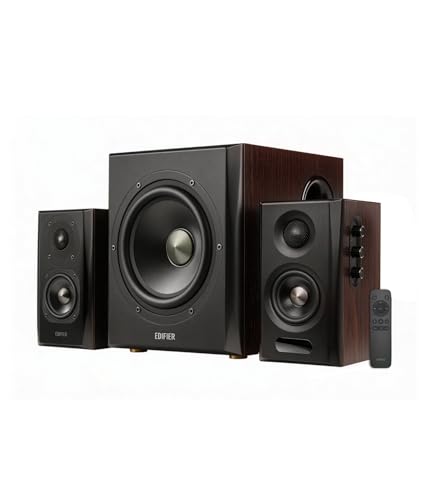


Why Add a Subwoofer to Bookshelf Speakers
Bookshelf speakers play most of the music and dialogue well, but small cabinets cannot produce the lowest octave. A subwoofer takes over that range, which adds weight to kick drums, bass guitar, film effects, and game explosions. It also relieves the small woofers of low notes, so the speakers play louder and cleaner in the midrange.
Not everyone needs one. In a small room at moderate volume, a good pair can be enough on its own. A subwoofer makes the most difference for movies, bass heavy music, and medium or large rooms.
2.1 Kits or a Separate Subwoofer
A 2.1 kit, with two speakers and a subwoofer from the same maker, is the simplest route. The pieces are matched, the crossover is set for you, and the wiring is short. Many kits connect to a television by optical or HDMI ARC and include Bluetooth and a remote.
A separate subwoofer gives you freedom to choose the size and the maker. It suits owners of passive speakers with a receiver or an amplifier that has a subwoofer output. The trade off is more setup, because you must match levels and the crossover yourself.
Choosing the Subwoofer Size
For a small room or a desk, a 6 to 8 inch subwoofer is usually enough. For a living room, 8 to 10 inches gives more reach without overwhelming the space. Bigger is not always better: a large sub in a small room can easily boom and excite the walls and the floor.
Look at the built in amplifier, the controls, and the connections. A level knob and a crossover control give you the tools to blend the sub with the speakers, while a phase switch helps when the sub is far from the speakers.
Setting the Crossover and Level
The crossover decides where the speakers hand off to the subwoofer. A common starting point is 80 Hz, a little higher for tiny speakers and a little lower for larger ones. Set the level so bass feels present but natural, then listen to voices and acoustic music as a check. If you can easily tell where the sub sits in the room, turn it down or move it.
If your receiver or amplifier manages bass for you, run its setup routine and then fine tune by ear. Make changes in small steps and listen with music you know well.
Placing the Subwoofer
Start near the front wall, between or beside the speakers. Corners boost bass but can make it uneven, so a central spot along the wall often sounds smoother. A useful trick is to place the sub at your seat, play bass heavy music, and crawl around the room to find where bass sounds best, then put the sub there.
Keep the sub off shared walls where possible and use isolation feet to reduce vibration through floors. This helps neighbors and also keeps the bass tighter.
Types of Setups Compared
| Setup | Best For | Watch For |
|---|---|---|
| Powered 2.1 kit | Desk, television, small living room | Less room to upgrade parts |
| Passive pair plus separate sub | Receiver based systems | More wiring and setup |
| Compact desk system | Computer and small rooms | Sub needs floor space |
Matching the Sub to Your Listening
Film and game fans usually want a bit more bass than music listeners, because explosions, engines, and orchestral hits carry real low energy. If most of your listening is music, a smaller sub set a little lower in level keeps the sound tidy and lets the bookshelf speakers do the talking. If you watch a lot of action films, a slightly larger sub with a movie mode can give effects the weight they need.
Room matters as much as taste. Rooms with hard floors and bare walls tend to amplify bass, so you may need a lower level than you expect. Carpeted, furnished rooms absorb more, and a little more level often sounds right. Adjust the level when the room changes, such as after adding a rug or moving furniture, and keep notes on the settings that worked.
Finally, consider upgrades. A kit with a remote and Bluetooth is convenient, while a separate sub with a good set of controls lasts through speaker upgrades. Think about which path you are more likely to enjoy over the next few years.
Quick Buyer Checklist
- Does the system include a crossover or bass management control?
- Is the subwoofer sized for your room rather than the biggest you can afford?
- Are there inputs for your television, computer, turntable, or streamer?
- Is there space for the sub near the front wall and a power outlet?
- Can the speakers stand alone if you ever move the sub to another room?
Common Mistakes
- Turning the subwoofer up too high because heavy bass feels impressive, which hides voices.
- Placing the sub in a corner without trying other spots.
- Skipping the crossover setting and letting the speakers and sub overlap.
- Choosing a huge sub for a small room.
- Forgetting that the sub needs its own power outlet and cable.
Cables deserve a moment of planning. Use a proper subwoofer cable (a single RCA lead) for the sub and keep it away from power cords to avoid hum. Wireless subwoofer kits remove that run, but they still need power at the sub, so choose a spot near an outlet before you commit to a layout.
Related Guides
For neighboring choices, see our guides to the best small subwoofer for bookshelf speakers, PC speakers with subwoofer, and powered bookshelf speakers.
Frequently Asked Questions
Do bookshelf speakers need a subwoofer?
Not always. Many pairs give satisfying bass for music and dialogue in a small room. A subwoofer helps with film effects and bass heavy music.
What size subwoofer suits a small room?
A compact 6 to 8 inch subwoofer is usually enough. Smaller subs are easier to place and less likely to overload a small room.
Where should I place the subwoofer?
Start near the front wall, then try a few positions. Corners boost bass but can make it uneven, while a central spot often sounds smoother.
Can I use bookshelf speakers with a subwoofer and a television?
Yes, if the speakers or amplifier accept your television output, such as optical, HDMI ARC, or analog audio. Check the connections before you buy.
How do I stop bass from bothering neighbors?
Keep the sub off shared walls, use isolation feet, and lower the level in the evening. A balanced system sounds full even at modest volume.
Final Thoughts
Choosing the best bookshelf speakers with subwoofer comes down to size, blend, and placement. Pick a 2.1 kit for simplicity or a separate sub for flexibility, set the crossover around 80 Hz, place the sub carefully, and use the product table to compare ready made systems.


