Best Battery Operated Outdoor String Lights (2026): Globe, Edison and Fairy Styles
Disclosure: We may earn a commission when you buy through links on this page, at no extra cost to you. As an Amazon Associate I earn from qualifying purchases. Learn more

No outlet on the patio? Compare the best battery operated outdoor string lights by style, length, timer and weather protection.
A patio, deck, or fence with no outlet nearby can still glow after dark. The challenge is picking the best battery operated outdoor string lights for your space, since strands vary widely in brightness, run time, and weather protection. This guide compares types by lumens and color temperature, style and finish, and ease of installation, so you can match a strand to your layout. Use the product table below to see the main options side by side.
Battery power gives you freedom that wired strands cannot. You can hang lights on a rental balcony, a garden arch, or a campsite shelter without running a cord across the ground. The trade off is that you must plan for battery changes or recharging, and brightness is often lower than wired options. The sections below walk through what matters most before you buy.


Types of Battery Operated Outdoor String Lights Compared
Battery strands fall into a few clear styles, and each style suits a different job. Start with the look and light output you want, then check run time and weather rating. If you are also weighing wired options for a permanent setup, our guide to the best outdoor string lights covers the wider category in one place.
Globe Bulb Strands
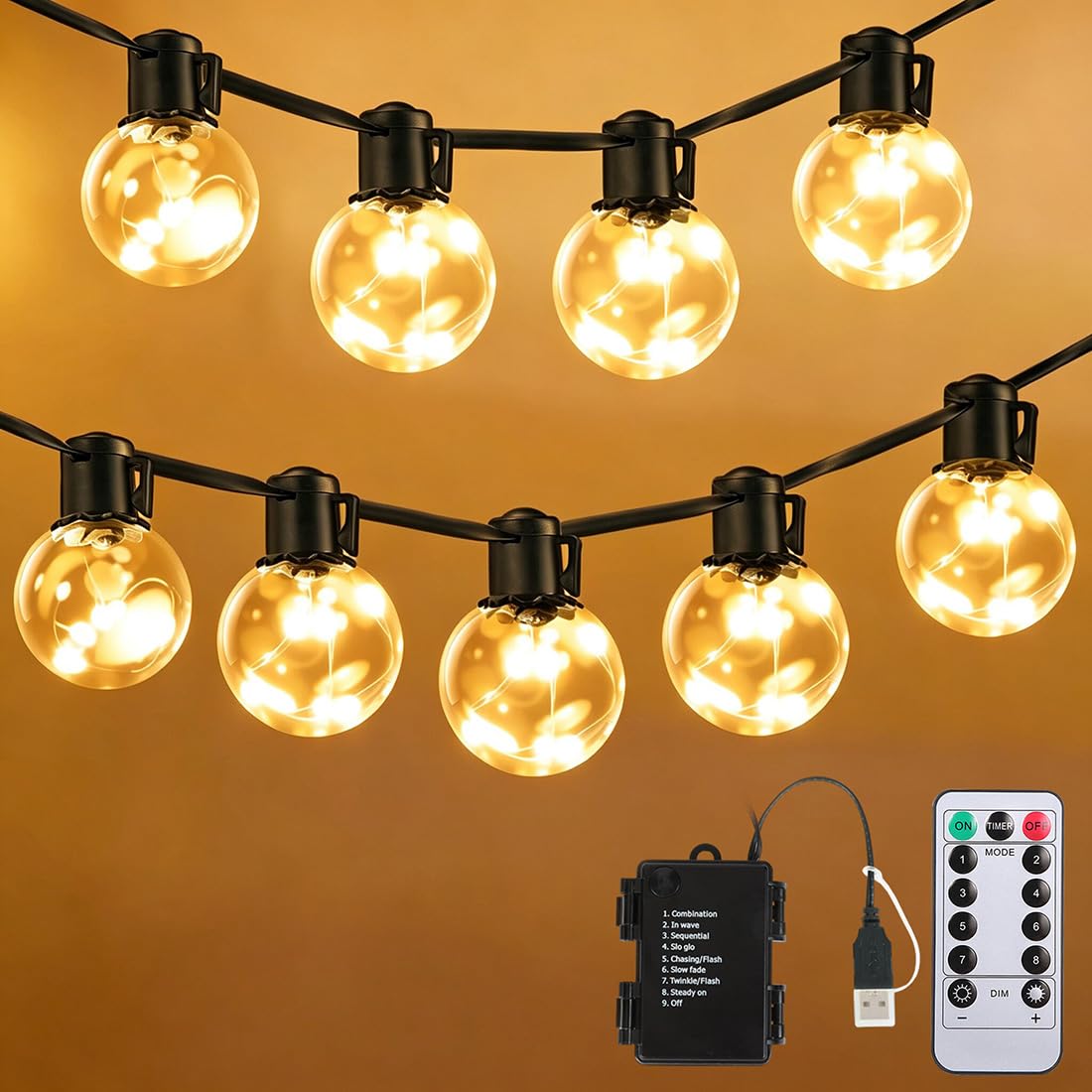
Globe strands use round bulbs that spread light evenly in every direction. They suit dining tables, pergolas, and seating areas where you want soft, even light rather than a focused beam. Bulbs are usually plastic on battery models, which keeps weight low and reduces breakage if a strand swings in the wind. Check bulb spacing before you buy, since wide spacing can leave dark gaps over a long run.
Edison Style Strands
Edison style strands copy the look of vintage filament bulbs, with a warm glow that flatters wood, brick, and outdoor furniture. They read more decorative than globes and often put out a little less usable light for the same power draw. Choose this style for mood and backdrop, and add a separate task light if you need to read, cook, or play games outside. Look for shatterproof bulbs if kids or pets use the space.
Small Bulb and Fairy Style Strands
Small bulb strands place many tiny points of light along a thin wire. They wrap easily around railings, branches, wreaths, and fence posts, and they hide well in daylight. Their total brightness is low, so treat them as accent lighting rather than your main light source. Because the wire is thin, handle it gently during setup and storage, and avoid tight bends that can damage the conductors inside.
Key Features to Compare
Five factors separate a strand you will enjoy from one that frustrates you. Brightness and color temperature decide how the space feels. Style and finish decide how it looks in daylight. Installation decides how fast you can hang it. Energy efficiency decides how often you swap or recharge batteries. Value balances all of that against price.
Read the listing details with those five factors in mind. Run time claims often assume the dimmest setting, so treat the longest claim as a best case and expect less at full brightness. A timer function helps a lot here, since lights that switch off on their own do not drain a full charge on a night when you forget them.
How to Choose the Right Outdoor String Lights
Size and Form Factor
Common lengths include 24 ft, 48 ft, 96 ft, and 100 ft, and longer is not always better. Measure your run first, including the drop from your anchor point to where the lights should start. A strand that is too long sags, pools on the ground, or forces awkward loops. A strand that is too short leaves the far corner dark. Leave a little slack for gentle swags, but keep the battery pack within easy reach.
Type
The market mixes many power and bulb types, including solar, LED, smart, color changing, shatterproof, commercial grade, Edison, globe, plug in, and battery operated models. For battery strands, LED bulbs are the sensible default because they sip power and stay cool to the touch. Our roundup of the best led outdoor string lights explains LED benefits in more depth. Pick battery power when an outlet is missing, far away, or off limits in a rental.
Features Worth Paying For
A remote control is worth paying for when the battery pack sits high or out of reach, since it lets you switch modes without a ladder. A built in timer is the other high value feature, because it runs the lights for a set number of hours each evening and then shuts them off. A dimmer helps you shift from dinner light to a softer glow later at night. Poles and mounting hardware matter less, since you can add them later if your layout changes.
Lumens and Color Temperature
Lumens tell you how much light a strand gives off, and battery models tend to sit at the lower end of the range. For gentle accent light, a modest output is fine, but a dining or cooking area needs more. Color temperature shapes the mood just as much. Warm light around 2200 to 2700 K feels cozy and flatters skin tones, while cooler light near 4000 K looks crisper but can feel harsh outdoors. Pick one temperature and stay consistent across strands.
Fixture Size and Placement
Bulb size changes both the look and the spacing you need. Large bulbs make a bold statement over a patio but look crowded on a narrow balcony railing. Small bulbs suit tight spaces and layered looks with plants or fabric. If you are planning a full yard layout, our guide to the best outdoor string lights for backyard walks through placement by zone. Keep bulbs clear of flammable items and out of standing water, and place the battery pack where rain cannot pool inside it.
Dimmable and Smart Options
Dimming extends battery life in a direct way, since lower brightness draws less power each hour. If you mostly use your lights at half brightness, a smaller battery pack may serve you well. App control and voice control appear on some battery models, but they add cost and can draw a small amount of standby power. For most patios, a remote and a timer cover the daily needs without extra complexity or extra drain.
Installation Without Wiring
Battery strands skip the hardwired versus plug in debate entirely, since there is no wiring and no outlet to reach. Hang the strand first with hooks, guide wire, or zip ties, keeping tension low so sockets do not twist. Insert batteries or charge the pack last, then test every mode before your guests arrive. Mount the battery pack at a height you can reach without a stool, because you will access it more often than any other part of the strand.
How Much Should You Spend?
Under about $30, expect a shorter strand, basic on and off control, and a modest weather rating suited to covered spaces. In the about $30 to $50 range, you gain longer runs, timers, and remotes. Between about $50 and $100, build quality improves, with sturdier sockets, better seals, and rechargeable packs. Above about $100, you are paying for very long runs, smart controls, or commercial grade parts, which most home patios do not need.
Battery Operated vs Other Outdoor String Lights: Pros and Cons
The core advantage of battery operated outdoor string lights is placement freedom. You can light a fence line, a tree, or a market stall with no outlet, no extension cord, and no trip hazard across a walkway. Setup takes minutes, and you can move the strand whenever the layout changes. For events and seasonal displays, that flexibility alone often settles the choice.
The limits are just as clear. Batteries add an ongoing task, and output usually trails wired strands, so a large yard may still need wired light for full coverage. Solar models remove the battery swapping chore but depend on sun exposure, and our guide to the best solar outdoor string lights shows when they work best. Think of battery strands as the flexible layer in your lighting, paired with fixed lights where you need steady brightness.
- Pro: works anywhere, with no outlet, cord, or electrician needed.
- Pro: fast to hang, move, and store between seasons or events.
- Con: run time is limited, and brightness drops as batteries fade.
- Con: ongoing cost and effort for replacement batteries if the pack is not rechargeable.
FAQs
What is the best battery operated outdoor string lights choice for most patios?
For most patios, the strongest choice is a mid length LED globe or Edison style strand with a timer, a remote, and a rechargeable pack. That mix covers the usual 20 to 30 ft span over a seating area, gives warm light for meals, and avoids weekly battery swaps. Add a second strand only if your seating splits into two zones, since one well placed run usually lights a standard patio evenly.
Are battery operated outdoor string lights worth it?
Yes, if your space lacks an outlet or you change your layout often. Renters, campers, and market vendors gain the most, because they can add light without altering the property or running cords. They are less worth it for a fixed pergola beside an outlet, where a wired strand gives stronger light with no charging routine. Match the power source to how permanent your setup is, not just to the upfront price.
How long do outdoor string lights last?
Bulbs on LED strands can last for many seasons, but the battery pack and seals usually set the real lifespan. A strand stored dry indoors over winter and kept out of standing water will outlast one left under snow and ice. Inspect sockets each spring for cracks and corrosion, and retire a strand if the wire insulation splits or the pack swells, since damaged parts near moisture are not safe to keep using.
Are expensive outdoor string lights worth it?
Spending more pays off mainly in seals, socket strength, and battery quality rather than raw brightness. A pricier strand tends to survive storms with fewer dead bulbs and hold a charge closer to its rating after many cycles. If your lights stay up all year in an exposed spot, that durability saves repeat purchases. For a strand used a few weekends each summer under a cover, a modest model usually serves just as well.
How do you clean outdoor string lights?
Remove the batteries first, then wipe each bulb with a soft cloth dampened with mild soapy water and dry the strand fully before you store or power it. Avoid soaking the battery pack or sockets, and never use a pressure washer on the strand. Our step by step guide on how to clean outdoor string lights covers stain removal and safe storage in more detail. Cleaning before storage also helps you spot cracked bulbs early.
What is the most reliable brand of outdoor string lights?
No single brand is most reliable for every buyer, because reliability depends more on the weather rating, seal quality, and battery type of the specific strand than on the name on the box. Check the IP rating for outdoor use, look for replaceable or rechargeable packs, and read recent buyer reports about dead bulbs and water entry. A strand with clear specs and easy returns is a safer bet than a famous name with vague ratings.
Final Thoughts
Start with your space, not with a listing. Measure the run, decide on globe, Edison, or small bulb style, and insist on a timer and a weather rating that match your exposure. The product table above can help you compare lengths, features, and battery types at a glance. When you choose the best battery operated outdoor string lights for your layout and habits, you get light exactly where you want it, with no cord in the way.