Best Adjustable Rolling Pins: Wood, Steel and Silicone Compared
Disclosure: We may earn a commission when you buy through links on this page, at no extra cost to you. As an Amazon Associate I earn from qualifying purchases. Learn more

The best adjustable rolling pin uses thickness rings for even dough. Compare wood, steel and silicone coated pins by drawer fit, care and price.
Picture a Saturday morning in a small kitchen. The counter holds a mixing bowl, a bag of flour, and cookie dough that needs to come out at one even thickness for the whole tray to bake at the same rate. A best adjustable rolling pin solves that problem with removable rings that set the thickness for you, so you stop guessing and stop reworking the dough.
This guide helps you choose by the things that matter at home: how much counter and drawer space you have, how many people you bake for, and what your budget allows. Use the comparison table below to see the main types side by side.



Quick Answer: The Types That Fit Real Homes
Most home bakers do well with a wooden or steel pin fitted with removable thickness rings. Wood suits cooks who bake often and want a warm, familiar feel on the counter. Steel suits bakers who chill their pin before working with butter rich pastry. Silicone coated pins suit sticky doughs and small kitchens where easy cleanup matters most.
If you are still deciding whether you need rings at all, start with our guide to the best rolling pin for a plain side by side look at standard styles. The sections below then narrow the choice to adjustable models and the homes they fit.
Before You Buy: A Quick Checklist for Choosing a Rolling Pin
Which Type Fits Your Routine
Start with how you actually bake. A French style pin is one tapered piece of wood with no handles, and it gives you close control for small rounds of pastry. A handled American style pin rolls on a center axle, so your hands stay off the barrel and the pressure stays even across wide sheets of dough.
Adjustable pins build on those shapes by adding rings at each end of the barrel. The rings lift the barrel off the dough once the sheet reaches the ring thickness, so the sheet stops getting thinner no matter how hard you press. If you like the control of a tapered shape, compare the best french rolling pin options before you commit to rings.
Household size matters too. A family rolling pizza dough for five people needs a longer barrel than a couple rolling two pie crusts, and longer barrels demand more clear counter space on each side.
Features Worth It, and Ones to Skip
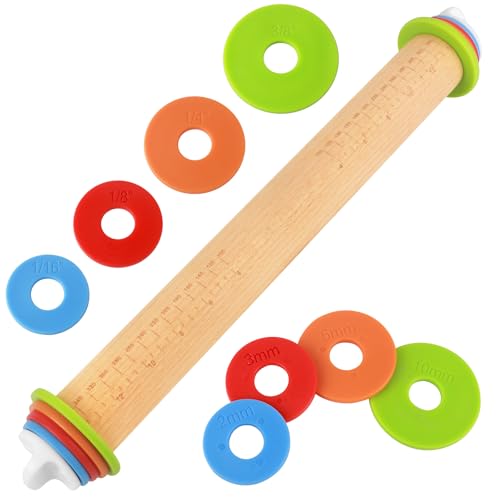
Thickness rings are the feature worth paying for. A useful set covers about 2 to 10 mm, with steps near 2, 3, 6, and 10 mm, so one pin handles thin pastry and thick cookie dough. Rings should slide on firmly and stay put while you roll, with no wobble at the ends of the barrel.
Measurement markings etched along the barrel help you roll a crust to a target width without reaching for a ruler. Etched markings last, while printed markings can fade with washing. Handles with smooth bearings are worth it for wide dough, since the barrel keeps turning when your hands stay still at the ends.
Skip pins with many ring sizes you will never use. Two or three thicknesses cover nearly all home baking, and extra rings mostly add drawer clutter. Our guide to the best rolling pin with thickness rings explains ring sets in more depth if you want to compare set sizes.
Finish, Coatings, and Heat Ratings
A light or dark wood finish changes only how the pin looks and how easily you spot flour on it. It has no effect on browning, because a rolling pin never goes in the oven and heat ratings do not apply to it.
Coatings matter in a different way. An uncoated wood or steel barrel relies on a light dusting of flour to release dough. A silicone coated barrel releases sticky dough with less flour, which helps when extra flour would toughen a delicate pastry.
Realistic Budget Ranges
Basic wooden adjustable pins often cost under $15. They give you the ring system and a solid barrel, with printed markings and simple handles. For many homes that bake a few times a month, this tier covers the job well.
Pins at about $15 to $30 usually add etched markings, smoother bearings, and rings that fit more precisely. Pins at about $30 to $50 tend to use stainless steel or thicker hardwood, and suit bakers who roll dough every week.
Types Compared: Three Styles of Adjustable Pin
Wooden Pin With Removable Rings
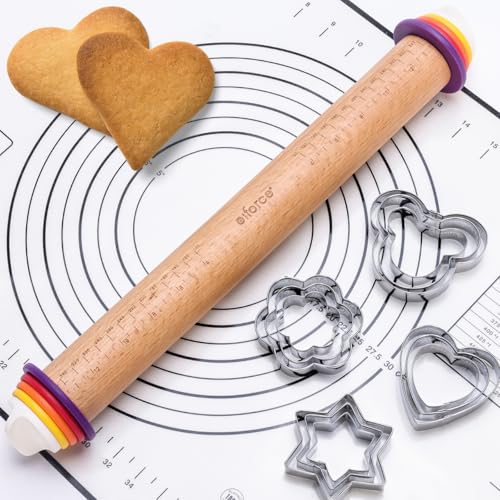
This is the most common style in home kitchens. The barrel is usually beech or a similar hardwood, the rings slide over the ends, and handles keep your palms off the dough. Wood feels warm in the hand and grips a light dusting of flour well, which helps the barrel move dough instead of sliding over it. If wood is your material of choice in general, the best wooden rolling pin guide covers plain models as well. Choose this style if you bake weekly, have a drawer that fits a pin of about 20 inches in total length, and prefer hand washing.
Stainless Steel Pin With Rings and Markings
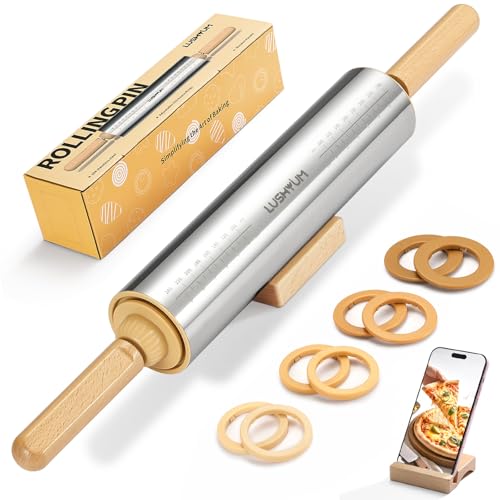
A steel barrel can go in the fridge before you roll, and a cold barrel helps keep butter in distinct layers inside pastry dough. Steel is smooth, so dough releases with a quick wipe, and most steel pins can go in the dishwasher once the rings come off. The trade off is weight: a steel pin is heavier in the hands. Choose this style if you bake butter rich doughs, want fast cleanup, and have sturdy counters.
Silicone Coated Pin With Rings
A silicone coating gives the barrel a release friendly surface that suits fondant, sugar cookie dough, and other sticky mixes. These pins often come in shorter lengths, which helps in apartments where counter runs are short. The coating can pick up knife nicks if you cut dough on the barrel. Choose this style if counter space is tight, you cut cookies often, and you want to use as little extra flour as possible.
Our Selection Process for Adjustable Rolling Pins
We judge adjustable pins on what a home baker feels at the counter: how even the finished sheet is, how firmly the rings hold their setting, how the barrel releases dough, material durability, and how easy the pin is to clean and store. We draw on maker specifications and patterns in verified buyer feedback. The rolling pin buying guide on this site walks through the same factors for every pin style.
What We Like and What We Do Not About Adjustable Pins
Adjustable pins remove the most common source of uneven baking: dough that is thick in the middle and thin at the edges. They also help new bakers build confidence, since the rings give clear feedback the moment the sheet reaches the target thickness.
- Like: one pin covers pie crust, cookies, pizza, and pastry by swapping rings.
- Like: even sheets bake at an even rate, so fewer trays come out with mixed results.
- Like: rings make it easy for two people in one household to match results.
- Do not like: rings can trap flour and moisture, so cleaning takes a little longer.
- Do not like: the widest ring setting limits how large a sheet you can roll under the barrel.
- Do not like: total length with rings and handles can exceed a standard kitchen drawer.
Plain pins still win on simplicity: no parts to lose, almost any drawer fits one, and they cost less. Adjustable pins earn their place when thickness is the problem you keep running into.
Common Buying Mistakes to Avoid
- Buying by barrel length alone. Total length with handles and rings is what your drawer must fit, and a pin that lives on the counter because it fits nowhere else quickly becomes clutter.
- Ignoring ring fit. Loose rings shift while you roll, so the sheet ends up uneven and the rings defeat their own purpose.
- Paying for huge ring sets. Most homes use two or three thicknesses, so a large set adds cost and storage bulk without adding results.
- Choosing steel for a fragile counter. A heavy steel pin dropped on a tile or stone edge can chip the surface, so match the pin weight to your kitchen.
- Skipping the space check. Wide dough plus a long pin needs clear counter on both sides, and a cramped layout makes a shorter pin the smarter buy.
Cost of Ownership and Care
An adjustable pin has almost no running cost. The only likely expense is a replacement ring if one goes missing, and ring sets are cheap compared with a new pin. Wooden pins ask for a light coat of food safe mineral oil now and then to keep the surface from drying out, and a small bottle lasts for years.
Wash the barrel in warm water with a small amount of soap, and take the rings off first so flour paste does not build up where the rings sit. Dry every part fully before storage, since trapped moisture can swell wood and dull steel. Store the rings on the pin itself so the set stays together. For a fuller routine, see our steps on how to clean a rolling pin, which cover stuck dough and odor removal as well.
Your Questions, Answered
Are adjustable rolling pins worth it for home bakers?
Yes, if uneven thickness is a regular problem in your kitchen. Think of the cost against what you stop wasting: one ruined pie crust or a tray of cookies with burnt edges can cost more in ingredients than the price gap between a plain pin and an adjustable one. Bakers who roll dough only once or twice a year will feel the benefit less, since practice alone solves most thickness issues at that pace.
What thickness setting should you use for pie crust, cookies, and pizza dough?
Use about 3 mm for pie crust, which stays sturdy enough to lift into a dish yet bakes through fully. Sugar cookies hold their shape well at about 6 mm, especially cut shapes that move from board to tray. Pizza dough is flexible, but about 6 mm gives a base that supports toppings without tearing. Fondant for cake covering goes thinner, near 2 mm, so it drapes without cracking at the edges.
How do you clean an adjustable rolling pin so the rings stay in good shape?
Scrape off dough with a bench scraper before any water touches the pin, since wet flour turns to paste and packs into the ring grooves. Wash the rings on their own in a small bowl so none slip down the drain. Set the rings on a peg or hook to air dry overnight rather than sealing them in a drawer while damp, because trapped moisture is what leaves rings sticking and smelling stale.
How long does an adjustable rolling pin last?
A wooden or steel barrel can serve for decades, and the rings are the part that decides the real lifespan of the set. Plastic rings can crack after years of use or heat exposure near a stove, while wood and metal rings tend to last as long as the pin. If a ring cracks, replace the ring set rather than the whole pin, and keep the spare rings stored on the barrel so the set ages together.
Can you use an adjustable rolling pin for fondant work?
Yes, and the thin ring settings are a real help, since fondant shows every uneven spot once it sits on a cake. Dust the barrel with cornstarch instead of flour, because flour can leave a dusty film that dulls colored fondant. Roll on a smooth mat and lift the pin straight up between passes rather than tipping it, since the raised rings can press lines into a finished sheet if the pin tilts.
Final Thoughts
For most homes, a wooden pin with a simple ring set is the best adjustable rolling pin balance of price, feel, and storage. Steel suits bakers who chill their pin for pastry, and silicone coated pins suit sticky doughs in small kitchens. Check the product table above against your drawer length, your counter space, and the doughs you roll most, and you will land on a pin your household reaches for every week.