
Best 50 Lb Adjustable Dumbbells: Buying Guide (2026)
Disclosure: We may earn a commission when you buy through links on this page, at no extra cost to you. As an Amazon Associate I earn from qualifying purchases. Learn more

Dial, block or plate loaded: how to pick a 50 lb adjustable dumbbell pair for home training, from increments to storage.
A full rack of fixed dumbbells takes up an entire wall, and buying pairs one at a time gets expensive fast. One adjustable pair solves both problems, but only if the weight range and the change mechanism fit the way you train. This guide to the best 50 lb adjustable dumbbells compares the main designs by build, footprint, and ease of use, and the comparison table below sums up how the types differ.
You will learn how dial, block, and plate loaded designs feel in daily training, and what the 50 lb limit means for common lifts. If you want the wider category view first, our guide to the best adjustable dumbbells covers heavier and lighter sets as well.


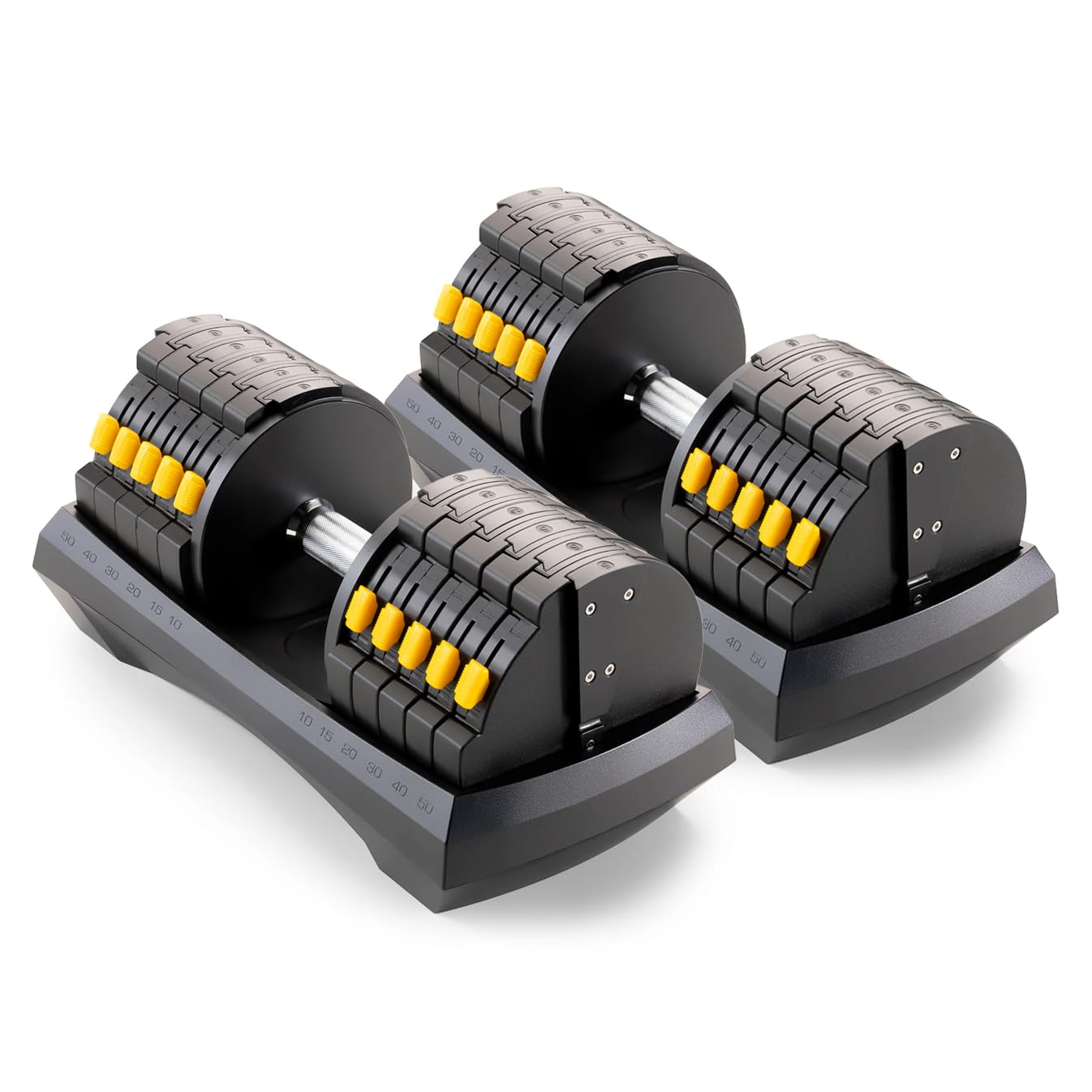


The Main Types at a Glance
Adjustable dumbbells in this class use three main systems.
- Dial systems sit in a cradle and connect to the plates you select, so changes take a few seconds.
- Block systems use a pin or a sliding handle to add nested plates, and the squared shape stays compact at every setting.
- Plate loaded systems work like small barbells, with loose plates held by a spin lock collar or a spring clip, which is simple but slower.
Three Designs Compared in Detail
Dial Systems for the Fastest Changes
Dial models keep their plates in a molded tray and let you pick a weight by turning a dial or pressing a selector on the handle. Unchosen plates stay behind in the tray, so changes are fast enough for circuits and supersets. The trade off is complexity, because selector parts are often plastic and the dumbbell must sit fully in its tray before the setting will change.
Block and Pin Systems for Compact Storage
Block models stack flat plates inside a squared frame, and you change the load by moving a pin or shifting the handle to a new slot. The shape stays short even at light settings, and weight sits close to your hand, so pressing and rowing feel balanced. Our bowflex vs powerblock comparison explains how dial and block systems differ in shape and handling.
Plate Loaded Systems for a Traditional Feel
Plate loaded dumbbells use a plain handle and loose metal plates, much like a short barbell. You slide plates on, lock them with a spin lock collar or a clip, and lift. The round plates and knurled handle feel familiar, and there is very little to break. Changes are the slowest of the three types, so this design suits steady strength work.
What Separates the Designs
The designs in this class differ on five points: build quality and weight capacity, footprint and storage, extra features, noise in use, and warranty length. The information comes from maker specifications and from patterns in verified buyer feedback, such as comments on rattle and tray wear.
How to Choose the Right Adjustable Dumbbells
Size and Form Factor
Adjustable sets come in classes such as 25 lb, 50 lb, 52.5 lb, 70 lb, 90 lb, and 100 lb per hand, and the class sets both the ceiling and the physical size. Dial models stay long even at light settings because the frame must hold every plate, while block models stay short. Check the length at settings you will use most, since a long dumbbell can bump your thighs during curls. Lifters close to this limit can compare the best 100 lb adjustable dumbbells before buying.
Adjustment Type
How a set changes weight shapes every workout. Dial and pin systems change in seconds, which keeps rest periods honest when a program calls for short breaks. Plate loaded systems take a minute or more per change, fine for slow strength sessions but frustrating in fast circuits. Also check whether changes need two hands and a flat tray, because that rules out mid set adjustments.
Features Worth Paying For
A stand is the feature most buyers value after the dumbbells themselves, because it holds the pair at knee height and saves your back from lifting 50 lb off the floor before every set. A storage tray matters for dial models, since it keeps plates aligned so the selector engages cleanly. Most other extras are safe to skip. Built in rep counters and screens add cost and one more part to fail.
Space and Footprint
A pair on its trays needs roughly the floor area of a doormat, and a stand trades some of that floor space for height. Measure your spot with the dumbbells at full length, and leave room to step back with a loaded pair in your hands. Closets and the space under a sturdy bench work well for block models. For layout ideas, see our guide to the best adjustable dumbbells for home gym setups.
Weight Capacity and Increments
The 50 lb figure means 50 lb per hand, so paired lifts can use up to 100 lb in total. Increments matter as much as the ceiling. Steps of 2.5 lb or 5 lb let you progress on curls, raises, and presses, while coarse steps of 10 lb feel limiting on smaller lifts. Check the lowest setting too, since many sets start at 5 lb or 10 lb. Our bowflex 552 vs 1090 comparison helps if you are torn between weight classes.
Programs and App Subscriptions
Some sets pair with an app that offers guided workouts, timers, and a place to log your sets. That guidance can help during your first months of training, when choosing exercises and loads feels uncertain. Read the terms before you pay more for a connected model, because the best content often needs an ongoing subscription after a trial ends.
Noise and Floor Protection
Adjustable dumbbells make more noise than fixed ones because plates shift slightly as you move. Block and plate loaded designs tend to clink at the top of a press, while dial models click in the tray. A rubber mat softens the sound and the impact if a dumbbell slips from a low height. Never drop an adjustable dumbbell like a fixed one, because selector parts can bend on impact.
How Much Should You Spend?
Under $100, you are usually looking at a single plate loaded dumbbell rather than a full pair. About $100 to $200 buys a basic plate loaded pair with spin lock collars. About $200 to $350 covers solid pin and entry level dial pairs. Above about $350, you pay for faster changes, smoother selectors, stands in the box, and longer warranties. Spend toward the top only if you change weights often.
Is a 50 Lb Set the Right Size for You?
For most home lifters, yes. Fifty pounds per hand covers years of pressing, rowing, lunging, and arm work, and two dumbbells together give you 100 lb for hip hinge patterns. The limit shows up first in heavy rows and in goblet squats once one dumbbell stops challenging your legs.
New and Returning Lifters
If you are starting out or coming back after a long break, a 50 lb ceiling gives you room to grow without a second purchase. Small starting weights and fine increments matter more than the top end, because your first months are built on light loads done well. For grip size and lighter starting weights, see our guide to the best adjustable dumbbells for women.
Home Lifters Focused on General Strength
If you train for health, muscle, and steady strength a few times a week, this class fits nearly every common dumbbell exercise. You can press, row, split squat, and carry at loads that stay challenging for a long time, and the compact footprint keeps a spare room or garage corner usable.
Stronger Lifters Close to the Limit
If you already row or floor press more than 50 lb per hand, a set in this class will feel light within months. Your options are a heavier class, a barbell for your biggest lifts, or slower tempos that make 50 lb feel hard again. Be honest about your current numbers before you buy, because the ceiling is the one spec you cannot change later.
Common Mistakes to Avoid
- Buying a single dumbbell when your program needs a pair, so two handed lifts have to be cut from your training.
- Dropping adjustable dumbbells like fixed gym weights, which can bend selector parts and leave you outside warranty coverage.
- Changing the setting while the dumbbell rests on the floor instead of its tray, so plates connect unevenly.
- Ignoring handle diameter, so a thick grip turns heavy rows into a grip test instead of back training.
- Storing the pair loose on a hard floor, so the dumbbells roll and pick up grit in the mechanism.
Care and Maintenance
Before each session, check that plates sit flush, that the selector or pin moves through every setting without force, and that spin lock collars are tight if your set uses them. A change that feels gritty is a sign to stop and inspect.
Store the dumbbells indoors on their tray or stand, off cold concrete and away from damp corners, because bare metal can rust over time. Keep the storage spot swept so grit stays out of the selector tracks. If a selector stops engaging fully, stop using that dumbbell and contact the maker about parts.
FAQ
Which 50 lb adjustable dumbbells are best for most people?
For most people, a dial or pin set with 5 lb increments is the easiest to live with, because changes are fast and the low settings suit smaller lifts. One detail worth checking is whether both dumbbells offer the same increments across the full range. A few sets change in fine steps at light weights and coarse steps at heavy ones, which can leave your hands mismatched.
What size adjustable dumbbells do I need?
Base the size on the strongest lifts you plan to train in the next two years, not on your first month. Write down your current working weights for a press, a row, and a squat pattern, then choose a class with clear headroom above the largest number. If you are new to dumbbells, start from loads you can handle for controlled sets of ten reps.
How long do adjustable dumbbells last?
A well kept set can serve for many years of home training. Lifespan depends mostly on the mechanism, because handles and plates rarely wear out, while selectors, pins, and trays absorb the daily wear. A long warranty on the mechanism is the best sign a set is built to last.
Are expensive adjustable dumbbells worth it?
They are worth it when you change weights many times in every session, because the time you save repeats hundreds of times a year. Divide the price by the years you expect to train and the premium often looks modest. They are not worth it if your program uses two or three set loads for weeks, since a basic plate loaded pair covers that pattern for less.
How do you clean 50 lb adjustable dumbbells?
Wipe handles and plates with a dry cloth after training to remove sweat before it sits on the metal. For a deeper clean, use a cloth dampened with mild soapy water on handles and plate faces only, then dry every surface fully. Keep water, sprays, and oils out of the selector and the pin tracks, because liquid inside the mechanism can cause sticking and rust. Finish by brushing out the tray.
Which adjustable dumbbell brands are most reliable?
No single brand is most reliable for every buyer, because reliability in this category tracks design more than name. Simpler mechanisms with fewer moving parts tend to fail least often, and brands that publish a clear warranty and stock spare parts are safer bets. Use the return window when you buy, and try every setting under a moderate load in your first week.
How do I choose the best 50 lb adjustable dumbbells for my space?
Check the length at the weights you use most, the increment size and whether the set needs a tray or stand. Then match the change speed to how often you switch weights in a workout.
Final Thoughts
Look back at the product table above and match each design to your routine. Pick a dial set if speed drives your training, a block set if floor space is tight, and a plate loaded set if simplicity and price matter most. The best 50 lb adjustable dumbbells for you are the pair you will not think about once the workout starts. Prices and availability can change, so check the product page before ordering.


