Best Body Pillows for Side Sleepers in 2026: Which Type Is Right for You?
Disclosure: We may earn a commission when you buy through links on this page, at no extra cost to you. As an Amazon Associate I earn from qualifying purchases. Learn more

The best body pillows for side sleepers start with the right shape. Compare straight, U, J and C styles by bed space, support and price.
Body pillows all promise the same thing, a long cushion to wrap yourself around, yet the shapes on offer could hardly be more different: a straight bar, a full wraparound, and two partial wraps that cover only part of you. Choosing between the best body pillows for side sleepers is really choosing a shape first, because shape decides how much of you gets supported and how much of your bed disappears.
This guide compares the four shapes directly, then covers the two jobs a side sleeper actually hires a body pillow to do, the honest costs in bed space and laundry, and the limits of what any pillow can claim. The comparison table below puts the shapes side by side so you can check prices and trade offs as you read.






Four Shapes of the Best Body Pillows for Side Sleepers, Compared
Every body pillow is a member of the same long, full length class, and every one of them is bought to do its work along the side of the body rather than only under the head. What separates them is geometry. Use the table to narrow the field, then read the shape notes for the details a table cannot hold.
| Shape | Best For | What It Does Well | Honest Trade Off | Typical Price |
|---|---|---|---|---|
| Straight rectangular | One sided huggers with limited bed space | Simple, affordable, easy to move and store | Supports one side only, so turning over means dragging it with you | about $25 to $60 |
| U shaped | Side sleepers who turn from side to side all night | Support in front and behind without moving the pillow | Takes most of a queen bed and costs a partner real space | about $50 to $120 |
| J shaped | Side sleepers who want head and knee support in less space | The hook reaches between the knees while the back stays open | Little support along the back itself | about $35 to $85 |
| C shaped | Smaller beds and sleepers who curl tightly | Wraps one side of the body in a compact curve | Can feel confining, and one size rarely flatters every height | about $35 to $85 |
Straight Rectangular: The One Sided Classic
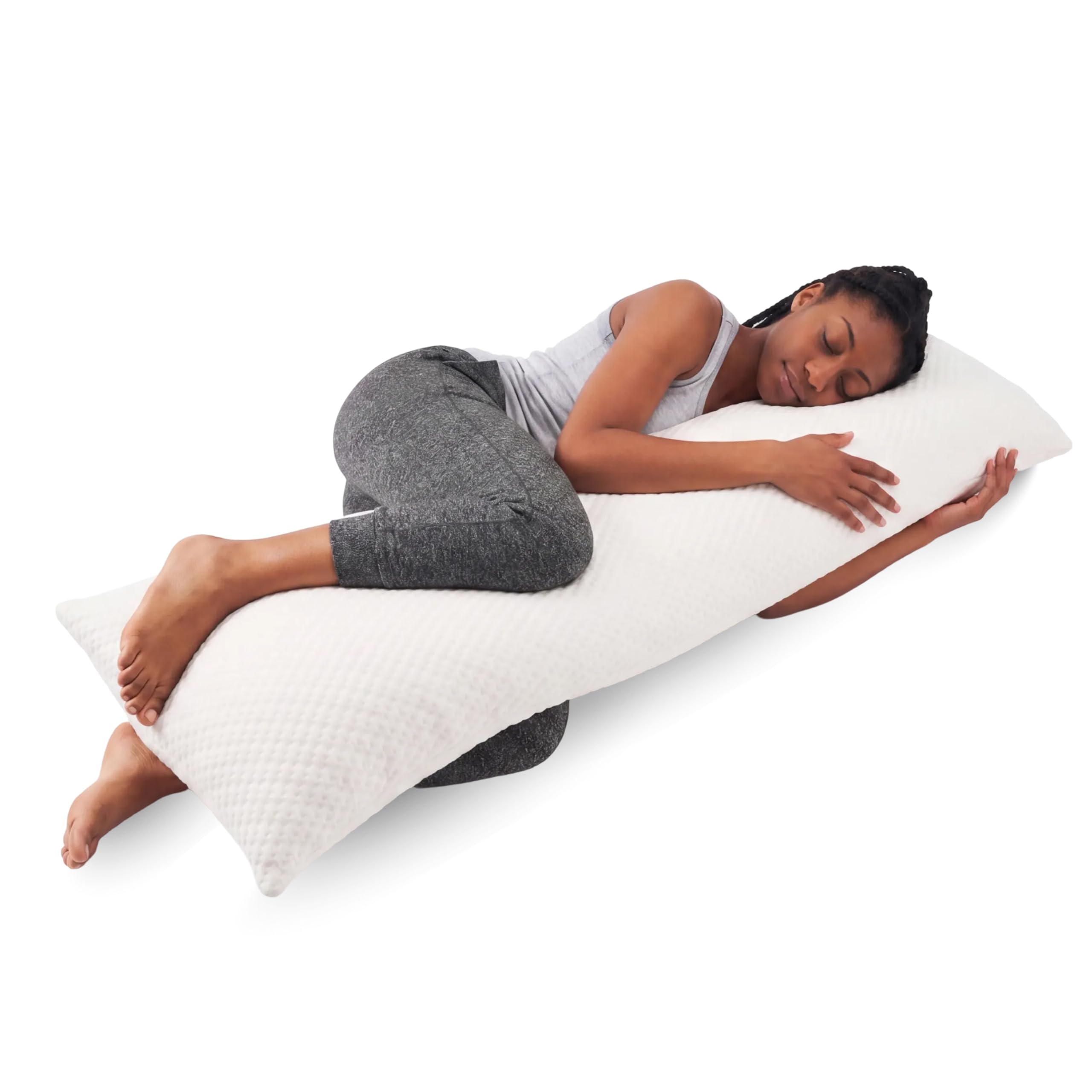
The straight body pillow is simply a long rectangle, usually about 50 to 54 inches, and it is the shape most people picture first. You lie on your side, rest your head on the top end or on your own pillow, drape one arm over it, and hold the lower length between your knees. It does both side sleeper jobs in the simplest possible form and fits standard body pillow cases that are easy to find and cheap to replace.
Its limits are the limits of a straight line. It supports only the side facing it, so when you roll over in the middle of the night you either drag it across the bed or leave it behind. It also has no opinion about your back, which stays unsupported. For a first body pillow, or for a twin or full bed where space is already tight, those are fair trades for the lowest price in the class and the easiest storage when guests need the bed.
U Shaped: A Pillow on Both Sides of You
The U shape runs down one side of you, curves under or past your feet area, and comes back up the other side, with your head resting on the curve at the top. Its real advantage is for restless side sleepers: turn left or turn right and there is a pillow waiting, with support along your back either way. Nothing else in this guide matches that all night coverage.
The price of that coverage is space, stated plainly: a U shaped pillow takes most of a queen bed by itself. On anything smaller it is effectively a one person bed conversion, and even on a king it claims the middle ground a couple may both want. It is also the most expensive shape here and the most awkward to wash, carry, and store. Buy it when the turning problem is the problem, and measure your mattress before you buy it at all.
J and C Shapes: The Partial Wraps
The J shape is a straight pillow with a hook at the bottom end, and the hook is the point: your head and torso rest along the straight length while the curve tucks between your knees. The C shape curves the whole pillow into an open crescent that wraps the front or back of a curled sleeper. Both aim to give targeted support while leaving part of the bed, and part of you, free.
These are the shapes for smaller beds and for sleepers who found a straight pillow almost right. Rollers who start on a side and end partway toward their stomach often prefer a partial wrap, because it leaves room to shift without climbing over a wall of fill. The honest limits are sizing and support: a curve cut for an average frame can land in the wrong place on a tall or short body, and neither shape braces your back the way a U does.
The Two Jobs a Side Sleeper Asks a Body Pillow to Do
Strip away the shapes and a body pillow has exactly two assignments: give the head a level resting height, and give the upper leg a place to rest so the knees and hips stack comfortably. A shape can be clever and still fail one of the two, so judge every candidate against both jobs before you judge it on fill or price.
Job One: Head Loft That Matches Your Shoulder
Side sleeping puts your shoulder under you, and the pillow has to fill the space between that shoulder and your head or your neck bends sideways all night. Many body pillows are thinner at the head end than a proper side sleeper head pillow, which is why plenty of owners keep a regular pillow for the head and use the body pillow from the shoulders down. If your head is the sensitive part, compare what you find here against the best sleeping pillows for side sleepers and consider running both.
People who split the night between side and back need a thinner head section, because a tall loft that suits the side pushes the chin forward on the back. If that sounds like you, the pillow families built for combination sleepers, such as the best pillows for back sleepers and side sleepers, handle the head end better, and a medium thickness body pillow will fight you less when you change position. Choose the head height for the position you actually sleep in most, not the one you fall asleep in.
Job Two: A Length Your Knees Can Hold
The lower half of the pillow is working equipment, not decoration. Resting the top knee on the pillow keeps the legs roughly parallel and stops the upper leg from dragging the whole body into a twist. For that, the pillow needs enough length to reach from your chest to past your knees, and enough thickness that your knees do not press through it to the mattress by morning. A pillow that is long but thin fails this job quietly, one compressed inch at a time.
Firmness matters here more than softness. A very soft fill feels lovely to hug and then collapses between the knees, which is the exact spot doing the work. Medium to firm fills hold the spacing. This is comfort mechanics, not medicine: the pillow is arranging cushions around you, and the check is simply whether you wake up having stayed comfortably where you settled.
Fills and How Each One Feels by Morning
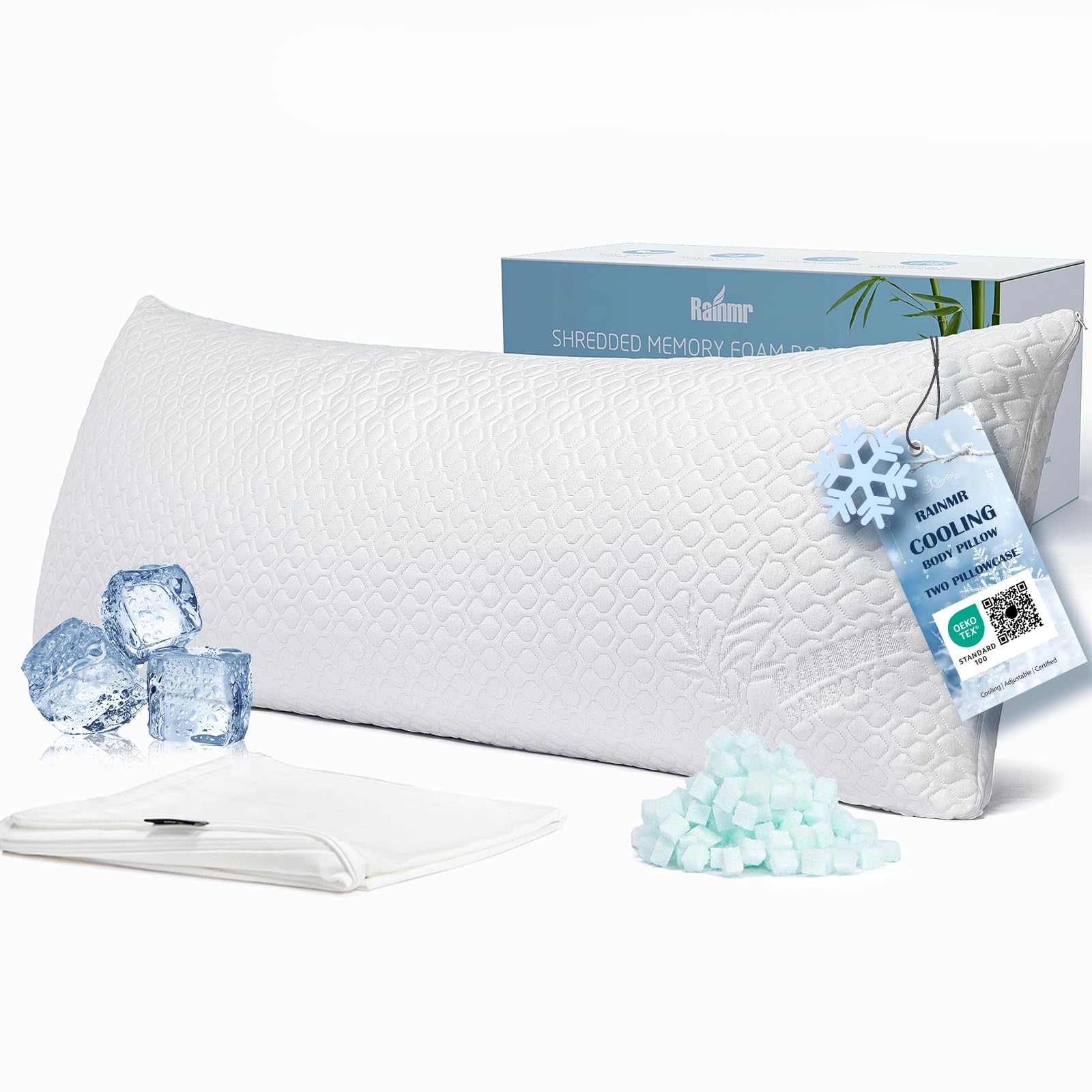
Shredded memory foam is the adjustable heavyweight: you can remove fill to slim the pillow, it holds knees apart reliably, and it is the heaviest option to haul to the laundry. A CertiPUR US label on foam means it is certified for content and emissions, which is a sensible screen on any foam you sleep against. Down alternative feels softer and cooler and suits huggers, but it packs down under knee pressure faster.
Solid foam and latex style fills push back rather than sink, which some side sleepers find supportive and others find unyielding, and they cannot be adjusted at all. Polyester fill is the budget entry, light and washable, and honest about its short life: expect noticeable flattening within about a year of nightly use. Match the fill to the job you care about most, knees or cuddle, because no single fill wins both.
Space, Partners, and Laundry: The Ownership Costs
Body pillows fail at home more often over logistics than over comfort. A few minutes with the unglamorous questions below, including the ones the product table cannot answer, prevents the most common returns.
How Much of the Bed It Really Takes
Be literal about width. A straight pillow claims roughly a fifth of a queen bed, a C or J a little more where it curves, and a U shape the majority of it. If you share the bed, your partner's opinion is a genuine buying factor, not a joke: the pillow will spend every night in space the two of you used to negotiate freely. Some couples land on a straight pillow precisely because it can be pulled close or pushed to the edge, something a wraparound shape will never allow.
Covers and the Washing Reality
Treat a removable, washable cover as close to mandatory. A body pillow is too big for most home washers, too slow to dry, and too expensive to replace when it starts to smell like a gym bag, so the cover is what actually gets laundered. Long covers are awkward laundry, wide and floppy and prone to tangling around everything else in the load, but they wash and dry in a normal cycle. Buy a spare cover at the same time as the pillow, because the pillow is unusable while its only cover dries.
A Short Note on Pregnancy Use
Many body pillows are bought during pregnancy, when side sleeping and a restless body make a long pillow genuinely useful. That use is about comfort only. Any question about sleep position, pain, or swelling during pregnancy belongs to her own clinician, and no pillow shape in this guide should be chosen as an answer to a medical concern.
Ratings and Reviews, Read With Care
Ratings on body pillows mostly measure how a shape matched the reviewer's bed and body, which may share nothing with yours. A roundup of the best reviewed pillows for side sleepers is a fine starting list, but treat glowing reviews of a U shape from a solo king bed owner as weak evidence for your shared queen. Look instead for reviews that mention bed size, partner, and washing, because those details transfer.
Hold the comfort claims to the same standard. A body pillow is bedding: it can make your side sleeping position easier to settle into and easier to keep, and it is not a treatment for back pain, hip pain, or any other condition. Alignment and orthopedic language on a listing is marketing, not a finding. If pain is persistent or worsening, or comes with numbness, tingling, or weakness, ask your doctor. Either way, look for a trial window with return terms you could actually use on a pillow this bulky.
A Simple Order for Choosing
- Measure the bed space you can honestly give up, and let that rule shapes in or out.
- Pick the shape that matches how you move at night: still, turning, or rolling partway over.
- Decide whether your own head pillow stays, because that changes how thick the head end should be.
- Choose a fill by the knee job first: firm enough to hold spacing until morning.
- Confirm the cover removes and washes, and add a spare cover to the order.
- Check the trial window and return terms before the price makes you skip them.
Body Pillows for Side Sleepers: Questions Answered
How long should a body pillow be for side sleeping?
Long enough to run from your head or shoulders down past your knees, which for most adults means at least about 48 inches. Height is the catch that averages hide: a sleeper over about 6 feet tall often finds standard lengths ending right at the knee, the one place support matters, and should look for the longest straight and J shapes. Measure yourself lying on your side, shoulder to knee, and buy against that number rather than against the word full size.
Can a body pillow replace my regular head pillow?
It can, but for many side sleepers it does not do the job as well. The head end of most body pillows is thinner and less shaped than a dedicated side sleeper pillow, so your head may sit lower than your shoulder needs. A common and comfortable setup is a proper head pillow plus the body pillow starting at the shoulders. Try the body pillow alone for a few nights first, since it costs nothing, and add the head pillow back if your neck complains.
Will a U shaped body pillow fit on a twin bed?
Barely, and only for one person who is happy to give the pillow most of the mattress. A U shape is commonly about as wide as a twin bed is, which leaves the sleeper sleeping inside the curve with no spare room on either side. On a twin, a straight or J shaped pillow is the practical choice. Save the U shape for a full bed used solo or a queen or larger, and even then, measure before ordering.
How do I wash a body pillow cover that is five feet long?
Wash it on its own or with a couple of light items, never stuffed into a full load, because a long cover twists into a rope and comes out half washed. A large capacity machine handles it best, and a laundromat trip is worth it if your washer is small. Zip or tie the cover closed first so it does not swallow other laundry. Dry it fully before putting it back, since the gathered folds hold damp long after the surface feels dry.
Do cooling covers on body pillows make a real difference?
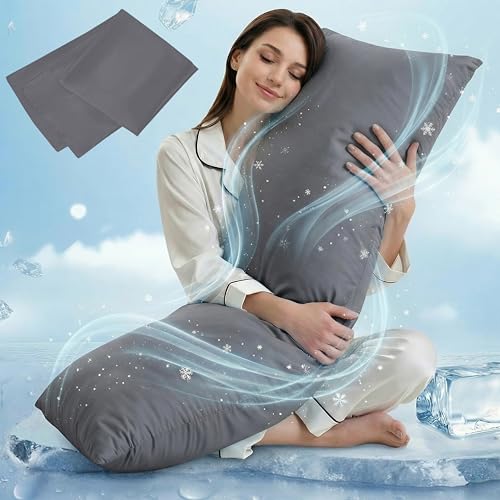
A modest one for the first part of the night. Cool touch fabrics feel cold on contact and then warm to body temperature like any other fabric, and a body pillow gives you far more surface contact than a head pillow, so the effect fades across more of you. A breathable cotton cover and a fill that does not trap heat, such as down alternative, do more over a full night. Room temperature still decides more than any cover can.
How often should a body pillow be replaced?
Replace it when it stops doing the knee job: when the middle has flattened enough that your knees press through to the mattress, the fill has gone lumpy in a way shaking cannot fix, or a smell survives washing the cover twice. Polyester fills reach that point fastest, often within about a year of nightly use, while shredded foam commonly lasts two years or more. Judging by function, not by the calendar, saves you money in both directions.
Final Thoughts
Choose the shape by your bed and your turning habits, judge it against the two jobs of head height and knee support, and budget honestly for a washable cover and a spare. The wraparound shapes earn their price only when the space cost is real to you and worth paying. Compare your finalists in the product table, and the best body pillows for side sleepers for your bed will be the ones whose trade offs you chose on purpose.