Best Adjustable Mandoline Slicers (2026): Buying Guide and Top Options
Disclosure: We may earn a commission when you buy through links on this page, at no extra cost to you. As an Amazon Associate I earn from qualifying purchases. Learn more

A practical guide to the best adjustable mandoline slicer: sizes, features, budget ranges, and mistakes to avoid before you buy.
Sunday lunch at a busy family home often means a mountain of potatoes, onions, and cucumbers on the counter, and a knife that makes every slice a different thickness. That is the problem the best adjustable mandoline slicer solves, since one dial or lever sets the thickness and every slice comes out the same. This guide helps you choose by kitchen space, household size, and budget rather than by the longest feature list. Our guide to the best mandoline slicer covers the full category, while the comparison table below sums up the adjustable styles side by side.






Quick Answer: Which Style Fits Your Home
For most homes, a bench model with a dial on the side is the sweet spot, since the dial clicks through clear thickness settings and the frame stays steady on the counter. Small kitchens do better with a flat model that hangs on a hook or slides into a drawer. Households that slice large amounts weekly should look at a wide steel frame model, since a broader deck handles cabbage halves and big potatoes without rocking. Space and routine matter more than small spec differences.
Before You Buy: A Quick Checklist for Choosing a Mandoline Slicer
Which Type Fits Your Routine
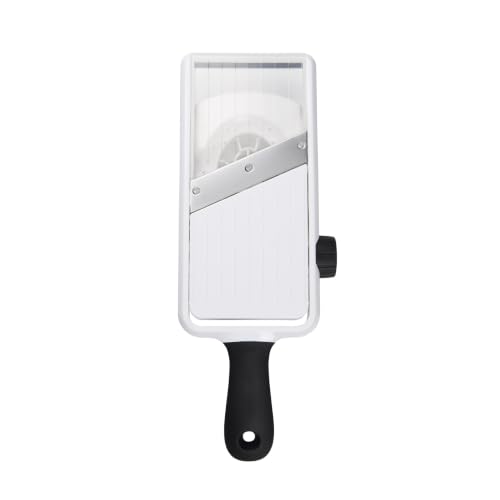
Bench models stand on folding legs over a bowl or board and suit cooks who prep several vegetables at once. Flat Japanese style models are light, store in a drawer, and use a simple knob to raise or lower the blade plate, and our guide to the best japanese mandoline slicer explains that style in depth. Handheld models slice straight over a pan or bowl and take almost no storage room, which the best handheld mandoline slicer roundup covers for very small kitchens. V blade models grip firm foods like apples and potatoes well, since the angled blades start the cut with less hand pressure.
Features Worth It (and Ones to Skip)
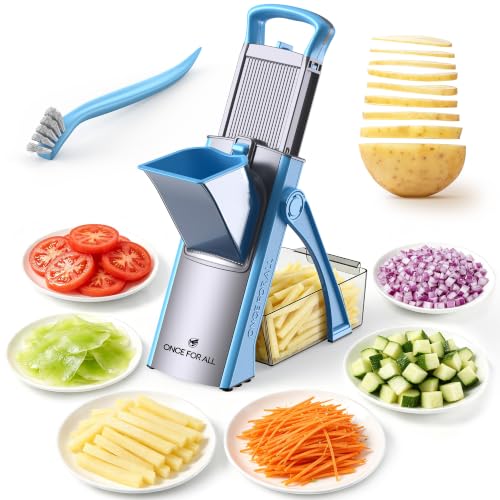
A thickness dial with marked settings is worth paying for, since you can return to the exact setting for tonight's gratin or next week's pickles without guessing. A sturdy hand guard that slides smoothly and covers the food fully is essential, and many cooks add cut resistant gloves for the last small piece of each vegetable. If safety is your top concern, the best safe mandoline slicer guide focuses on guard design and grip. Julienne blades are worth it if you make slaws and stir fries often. Skip large insert sets you will rarely use, since each extra blade is one more sharp part to wash and store.
Materials and Food Safety
Blades are stainless steel on nearly every model, and the real choice is the frame. All steel frames feel rigid and shrug off years of use, but they cost more and weigh more. Plastic frames keep price and weight down, and food grade plastic labeled BPA free is a sensible pick for parts that touch food briefly. Check that the blade sits firmly with no wobble, since a blade that shifts changes slice thickness mid stroke and can catch on firm foods. Rubber feet matter too, because a slicer that slides is both annoying and unsafe.
Dishwasher Safe or Hand Wash
Many plastic bodies and guards can go on the top rack of the dishwasher, but blades deserve hand washing even when the maker allows the dishwasher. Machine washing dulls sharp edges over time, and a loose blade in a basket is a hazard for whoever empties it. Wash the blade with a brush, moving from the blunt back toward the edge never across it, then dry it right away and store it covered. A model that comes apart into a few large pieces is far easier to clean than one with tight slots where food dries in place.
Realistic Budget Ranges
Under $20, expect a simple flat or handheld adjustable slicer with a basic guard, fine for salads and occasional slicing for one or two people. About $20 to $50 buys the most choice, including dial adjustable bench models with julienne blades, better guards, and sturdier frames for family cooking several times a week. About $50 to $100 brings wider steel frames, smoother dials, and replaceable blade systems for heavy use. Spending more mainly buys rigidity and durability, so match the tier to how often you cook.
Types Compared: Three Adjustable Styles for Real Homes
Dial Adjustable Bench Models
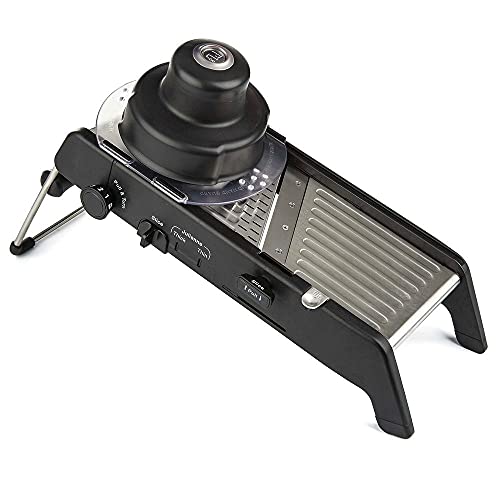
A dial on the side or under the deck raises and lowers the slicing plate, usually from paper thin up to about 6 to 9 mm, which covers cucumber rounds, onion slices, and potato gratin layers with one tool. The legs fold flat, so the slicer stores in a cupboard. This style suits families who cook four or more nights a week and want repeatable results without measuring. The trade off is size, since a bench model needs a clear stretch of counter and a bowl beneath the legs. Prices usually sit in the middle tier at about $25 to $50.
Simple Lever or Knob Models
Flat models with a small knob under the plate offer fewer set thickness points, but they cost less and store almost anywhere, including a utensil drawer. They shine for quick jobs like slicing one onion for sandwiches, where setting up a big bench model feels like too much fuss. The trade off is precision, since unmarked knobs ask you to test the first slice and adjust by feel. For small households, students, and occasional cooks, that compromise is easy to accept, and most of these models cost under $25, gloves included in most budgets.
Wide Steel Frame Models
Steel frame models pair a rigid body with a wide deck that takes halved cabbage, large sweet potatoes, and big onions without tipping or flexing. Their dials tend to move in fine steps, which helps when you want even slices for chips that cook at the same rate. Replacement blades are easier to find for this class, so the slicer can stay in service for years instead of being replaced when the edge dulls. The trade offs are weight, price in the about $50 to $100 range, and storage, since a wide frame needs a real cupboard shelf.
How to Judge an Adjustable Mandoline Slicer
Weigh five things in this order: ease of use, safety of the guard, cleaning effort, fit with your storage space, and value for your cooking volume. Ease of use means a dial you can turn with damp hands and markings you can read at a glance. A slicer that scores well on the first three and fits your kitchen beats a feature packed model that lives at the back of a cupboard because washing it is a pain.
Adjustable vs Other Mandoline Slicers: Pros and Cons
The big win with an adjustable model is range. One tool covers thin garlic chips, medium cucumber slices, and thick potato rounds, so you do not need a drawer of fixed thickness slicers. Settings also repeat, which matters for recipes like scalloped potatoes where uneven slices cook unevenly. The downside is that moving plates add cleaning nooks, and cheap dials can drift under pressure from hard foods like carrots. Fixed Japanese models are simpler and often sharper, while a food processor slices fast but with less thickness control, a trade off explored in mandoline vs food processor.
- Like: one tool covers nearly every thickness a recipe asks for.
- Like: marked settings make results repeatable meal to meal.
- Don't like: moving parts take longer to wash than a flat fixed model.
- Don't like: cheap dials may flex or drift on hard squash and carrots.
Common Buying Mistakes to Avoid
- Buying wider than your storage: a wide frame with no home ends up stored with the blade exposed, risking the edge and your fingers.
- Ignoring the guard: a small or wobbly guard makes the last part of every vegetable risky, so check guard size before price.
- Paying for inserts you will never use: waffle and crinkle blades sound fun, but each unused insert still needs storage.
- Choosing by thinnest setting alone: most recipes need even slices more than extreme thin ones, so dial smoothness matters more.
- Forgetting replacement blades: a model with no spares becomes a throwaway item once the edge dulls.
- Slicing without protection to save time: rushing the last piece of an onion without the guard is how most mandoline cuts happen, and a deep cut that will not stop bleeding needs urgent care.
Cost of Ownership and Care
Owning a mandoline costs little beyond the purchase. Budget for replacement blades every year or two under heavy use, a pair of cut resistant gloves at about $10 to $15, and a storage case if your model lacks a blade cover. Rinse the slicer right after use so starch and onion juice do not dry onto the plate, and follow the steps in how to clean a mandoline slicer for safe brush technique around the edge. Store it with the blade set to its closed position, or inside its cover, never loose in a drawer. Keep it dry between uses, since standing moisture dulls edges.
Your Questions, Answered
What is the most reliable mandoline slicer brand?
No single brand owns reliability in this category, because durability tracks design more than the logo. Look for a frame that does not flex when you press the middle of the deck, a dial that clicks firmly into each setting, and spare blades sold separately by the maker. A brand that sells replacement parts supports its products longer than one that only sells complete units. Those checks predict years of service better than any reputation claim.
Is a mandoline slicer worth it for a small household?
For one or two people, it depends on how you eat. If you make salads, pickles, gratins, or stir fries most weeks, even a compact model earns its drawer space by turning ten minutes of knife work into two minutes of slicing. If you mostly cook one pan meals with rough chopped vegetables, a good knife covers your needs and the slicer will gather dust. Count how often you wished for even slices last month, and buy only if the answer is more than twice.
How long does a mandoline slicer last?
The frame of a decent adjustable model can last many years, while the blade is the wear part. With weekly use, expect the edge to feel less keen after about a year or two, sooner if it goes through the dishwasher or rattles loose in a drawer. Models with replaceable blades return to like new performance with a swap, which is why checking spare blade availability before you buy protects the purchase. A bent plate or cracked dial housing, though, means retiring the slicer for safety.
Are adjustable mandoline slicers worth it over fixed ones?
Adjustable models earn their keep when your cooking spans thin and thick slices, since one tool replaces two or three fixed plates. They also help when a recipe names a thickness, because you can set the dial and trust it across a whole batch of potatoes. Fixed models still win on simplicity and price, with fewer parts to clean. If you only slice cucumbers at one thickness, fixed is fine. If your menu changes weekly, adjustable is the practical choice.
Can an adjustable mandoline slicer handle hard vegetables like sweet potatoes?
Yes, with the right setup. Choose a wide, rigid frame, set a medium thickness rather than the thickest setting, and let the guard press the food down with steady, even strokes. Hard produce punishes flexible frames, which can bow and change thickness mid stroke. Cut a flat face on one side of the sweet potato first so it sits stable against the deck. Work slowly and stop while a safe stub remains for the guard, then compost that last piece or cook it another way.
Final Thoughts
The right choice comes down to your kitchen and routine. A dial adjustable bench model suits most families, a simple flat model keeps small kitchens happy on a tight budget, and a wide steel frame rewards heavy weekly use. Whichever style you pick from the product table above, put guard quality and storage fit ahead of extra inserts. Chosen that way, the best adjustable mandoline slicer for your home is the one you reach for on a Tuesday, already set for dinner.