Best Coil Garden Hoses for 2026: The Buyer Checklist
Disclosure: We may earn a commission when you buy through links on this page, at no extra cost to you. As an Amazon Associate I earn from qualifying purchases. Learn more

Best coil garden hoses spring back into a neat coil and resist kinks. Compare length, material, fittings and reach for patios, RVs and small yards.
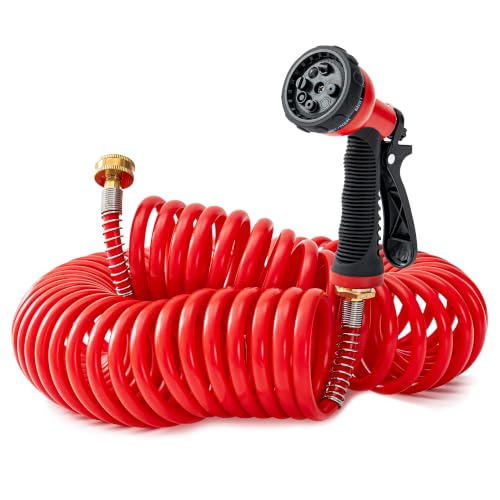
A regular garden hose is a tangle waiting to happen. It kinks, drags through flower beds and takes up a corner of the garage. A coil hose does the opposite: it springs back into a neat spiral, stays off the ground and tucks away on a hook. The best coil garden hoses suit small yards, patios, balconies, decks and RVs, where a hose has to be handy and tidy.
The product table above lists coil hoses in lightweight and heavy-duty builds, with various lengths and fittings. This guide explains how they work, how far they reach and how to choose between them.




How the best coil garden hoses work
A coil hose is made of flexible plastic or rubber that has been formed into a spiral shape. When you pull it, the coil stretches out to a longer length. When you let go, it pulls back toward its original shape.
This memory means the hose never sits in a heap, and it shortens itself after use. It also resists kinking, since the spiral absorbs bends.
Reach versus coil length
A coil hose stretches, but it does not reach as far as its listed length without pulling hard. A fifty foot hose, for example, may stretch to its full length only with force, and in daily use you will notice some tension. Choose a length slightly longer than the distance you need, so the hose is relaxed when you water.
If you only need to water a few pots by a back door, a short hose is lighter and neater. If you water a garden bed far from the tap, choose a longer hose or add an extension.
Material and weight
Most lightweight coil hoses are made from a plastic called EVA, which is flexible and light. Heavier models use rubber or reinforced layers, which handle more pressure and last longer. Lightweight hoses are great for patios and balconies, while heavy-duty ones suit frequent use and rough ground. Drinking water safe models are available for RVs and camping.
Diameter and flow
Hose diameter affects the flow. A narrower hose gives less water for the same pressure, which suits light watering and cleaning. A wider hose delivers more, which helps with larger jobs. A coil hose often has a narrower bore than a standard hose, so check the flow if you fill big buckets or run sprinklers.
Connectors and fittings
Brass fittings last longer than plastic and resist cross-threading. Look for a swivel or a crush-resistant collar, and check whether the hose comes with a spray nozzle. Some include quick-connect fittings that let you swap nozzles easily. Make sure the thread size matches your tap, which in the United States is a standard garden thread.
Storage and care
The best coil garden hoses are easy to store, since they spring into a compact form. Hang the hose on a hook or lay it in a bucket. Drain it after use, and keep it out of direct sun when not in use, since heat and light can weaken plastic over time. In freezing weather, bring it indoors and drain it completely.
Where coil hoses fall short
Coil hoses are not built for heavy, constant duty or very long runs. They can pull on the tap if stretched too far, and the coil tends to tug when you move around. Trees, rocks and thorns can damage thin walls, so choose a sturdier hose for rough areas.
Price and value
The hoses in the table range from about $22 to $75. Low-cost hoses are fine for light use. Higher-priced hoses use stronger materials and better fittings. Pick according to how often you will use it.
Everyday jobs for a coil hose
A coil hose handles the small daily jobs very well: topping up hanging baskets, filling a watering can, rinsing the patio, washing the dog's paws, cleaning a bike or hosing off a grill. Its light weight makes it easy to carry up steps and around corners. For a larger lawn or a long vegetable bed, a standard hose on a reel is usually a better fit.
Setting up a hose station
Mount a hook or a wall bracket near the tap, so the hose hangs in a loose loop. Add a quick-connect fitting at the tap and another on the hose, so you can attach and remove it in seconds. Keep a nozzle clipped on the hose end and a spare washer in a drawer. A tidy station encourages you to use the hose and to put it away.
If you have a balcony, check any rules about water use and drainage before setting up.
Fixing common coil hose problems
If the coil becomes loose or stretched, hang it in warm water for a few minutes, then let it cool in a tight coil to restore its shape. If a connector leaks, check the washer and tighten by hand, and replace the washer if it is cracked. If the hose twists, let it hang free and untwist it from the tap end. A pinhole leak can be sealed temporarily with a repair tape, but a hose with several leaks needs replacing.
Making a coil hose last longer
Do not run over it with a mower or leave it in a hot car. Turn off the tap after use, release the pressure by opening the nozzle, then drain the hose. Wipe off dirt and keep it in a shady place. A hose that is cared for will give several seasons of service, and replacement parts such as washers and nozzles cost very little.
Common questions
Do coil hoses kink?
Rarely. The spiral shape absorbs bends, though a sharp pull can still twist it.
How long do they last?
Several seasons with proper care, and longer for heavy-duty models.
Are they safe for drinking water?
Only models labeled drinking water safe. Check the listing.
Can I leave one outside in winter?
Drain and store it, since freezing water can damage the hose.
Final thoughts
The best coil garden hoses stay tidy, resist kinks and reach where you need. Compare length, material and fittings in the table above, and choose the hose that suits your space.