Best 4 Inch Component Speakers of 2026: Complete Buying Guide
Disclosure: We may earn a commission when you buy through links on this page, at no extra cost to you. As an Amazon Associate I earn from qualifying purchases. Learn more
Use this buying guide to the best 4 inch component speakers to compare sound, fit, materials, and power needs for cars, small rooms, and compact setups.
A component speaker set separates the woofer from the tweeter, so each driver does one job and does it well. That separation is why the best 4 inch component speakers sound clearer than single point designs at the same size, whether they end up in a car door or on a small shelf. The buying catch is that you now choose a system, not a single speaker, and the crossover, fit, and power source all shape the result.
This guide walks through three price profiles, the features that matter, and the main types.
Three Profiles at a Glance
Rather than naming individual models, this section describes the three profiles that cover most needs and budgets.
Balanced Profile
The balanced profile, usually about $80 to $150 a pair, combines a treated or coated cone woofer, a soft dome tweeter, and a real external crossover with level adjustment. It suits the widest range of uses: front doors in a daily driver, a compact stereo pair in a small room, or a desk setup with a modest amplifier. Expect RMS handling around 40 to 60 watts and a smooth handover between drivers. Its limitation is installation effort, because separate tweeters and crossover boxes always take longer to place well than a single coaxial unit.
Value Profile
The value profile, usually about $40 to $80 a pair, keeps the separate tweeter and a simple crossover while trimming cabinet grade materials and hardware. Sound stays a clear step above one piece speakers, especially for vocals, because the tweeter can sit nearer ear level. This profile suits first systems, spare rooms, and cars that see moderate volume. Its weakness shows up at high output, where simpler crossovers pass more strain to the tweeter. Buy it knowing your listening stays civilized, and it will reward you for years.
Best Premium Profile
The premium profile, usually about $150 to $300 a pair, invests in driver materials, crossover parts, and build tolerances. Cones may use woven or layered materials that resist flexing, tweeters extend higher with less grain, and crossovers offer finer adjustment. This profile suits listeners who already own a clean amplifier and a quiet space, because it reveals both good and bad recordings honestly. The trade off is diminishing returns in noisy rooms or cars. If road noise or room echo dominates your listening, spend on placement and treatment before stepping up to this tier.
How to Choose: The Complete Buying Guide
The seven checks below cover everything that decides whether a component set satisfies you. They apply equally to car and home use, with the differences noted where they matter. Shoppers focused on vehicles should also read our guide to the best 4 inch component car speakers, which treats door and dash fitment in depth.
Sound Quality and Tuning
Clarity in a component set comes from the crossover region, where the woofer hands over to the tweeter, usually between about 3,000 and 5,000 Hz. A well tuned set keeps voices seamless through that handover, with no dip or glare. Look for a stated crossover point and tweeter level settings, which let you adapt the balance to a bright room or a soft one. Frequency response figures help only when a tolerance is stated. Trust driver materials and crossover design more than a long response claim, and remember that the best 4 inch component speakers still obey physics on bass, rolling off well above the deepest notes.
Fit, Footprint, and Weight
For speakers, fit means the woofer cutout and depth, the tweeter mounting style, and the space the crossover occupies. Measure all three before ordering. On a shelf or desk, footprint and weight matter instead: a compact set should leave room for the amplifier and should sit stably where you place it. Surface mount tweeter cups add flexibility in both settings because they need no cutout. Keep the total system size in mind, since a small speaker paired with a bulky crossover and amp is no longer a small system.
Connectivity and Wiring
Component speakers are wired devices. The woofer, tweeter, and crossover connect with speaker wire, and the set connects to an amplifier or receiver, never directly to a phone. Bluetooth, when it appears in such a system, lives in the source, such as a streaming amplifier, and has no effect on how the drivers themselves connect. Check terminal style before buying. Binding posts or firm push terminals make solid connections that survive vibration in a car and dusting in a home, while thin spring clips are the first thing to budget for replacing.
Durability and Water Resistance
Indoor sets need little more than sturdy cones and secure terminals, but car doors and covered outdoor spaces demand moisture resistant materials. An IP rating appears only on sets built for exposed locations, and most component sets carry none, which is fine for cabins and rooms. For damp duties, choose sealed cones, rubber surrounds, and coated baskets, or step across to our guide to the best 4 inch marine speakers. Heat matters as much as water. Adhesives and surrounds age fastest in sun baked cars, so garage parking extends the life of any set.
Noise Control and Isolation
Component speakers do not contain active noise cancellation, because ANC belongs to headphones and a few powered products with microphones. What you control instead is the noise around the speakers. In a car, door deadening lowers road roar and stops panel buzz, which reads to your ears as cleaner sound. At home, soft furnishings and sensible placement tame echo. Isolation works at the source too: a rubber gasket or foam pad under a shelf speaker stops vibration from traveling into the furniture and coloring the tone.
Power Needs Instead of Battery Life
These speakers are passive, so there is no battery and nothing to recharge. The real specification is power handling, stated as RMS watts, matched against what your amplifier delivers per channel. A set rated around 40 watts RMS pairs happily with most compact amplifiers and car head units. Sensitivity tells you the other half of the story: a rating near 90 dB means satisfying volume on modest power, which matters for small amplifiers. Underpowering is rarely dangerous by itself, but turning a small amp up into distortion is, because clipped signals overheat tweeters.
Placement and Room Size
Small drivers suit small spaces. In a room, place the woofers at ear level when seated, keep the tweeters aimed toward the listening spot, and give the pair some distance from rear walls so bass stays tidy rather than boomy. A stereo pair of 4 inch components fills a bedroom, office, or small den with ease, but a large open living area will ask more of them than they can give. In that case, step up in woofer size, as our guide to the best 6 inch component speakers explains, or add a subwoofer and let the small set handle what it does best.
Types of 4 Inch Component Speakers
Most sets fall into one of three use families. Knowing which family you are buying prevents the common mistake of judging a nearfield set by living room standards.
Gaming Models
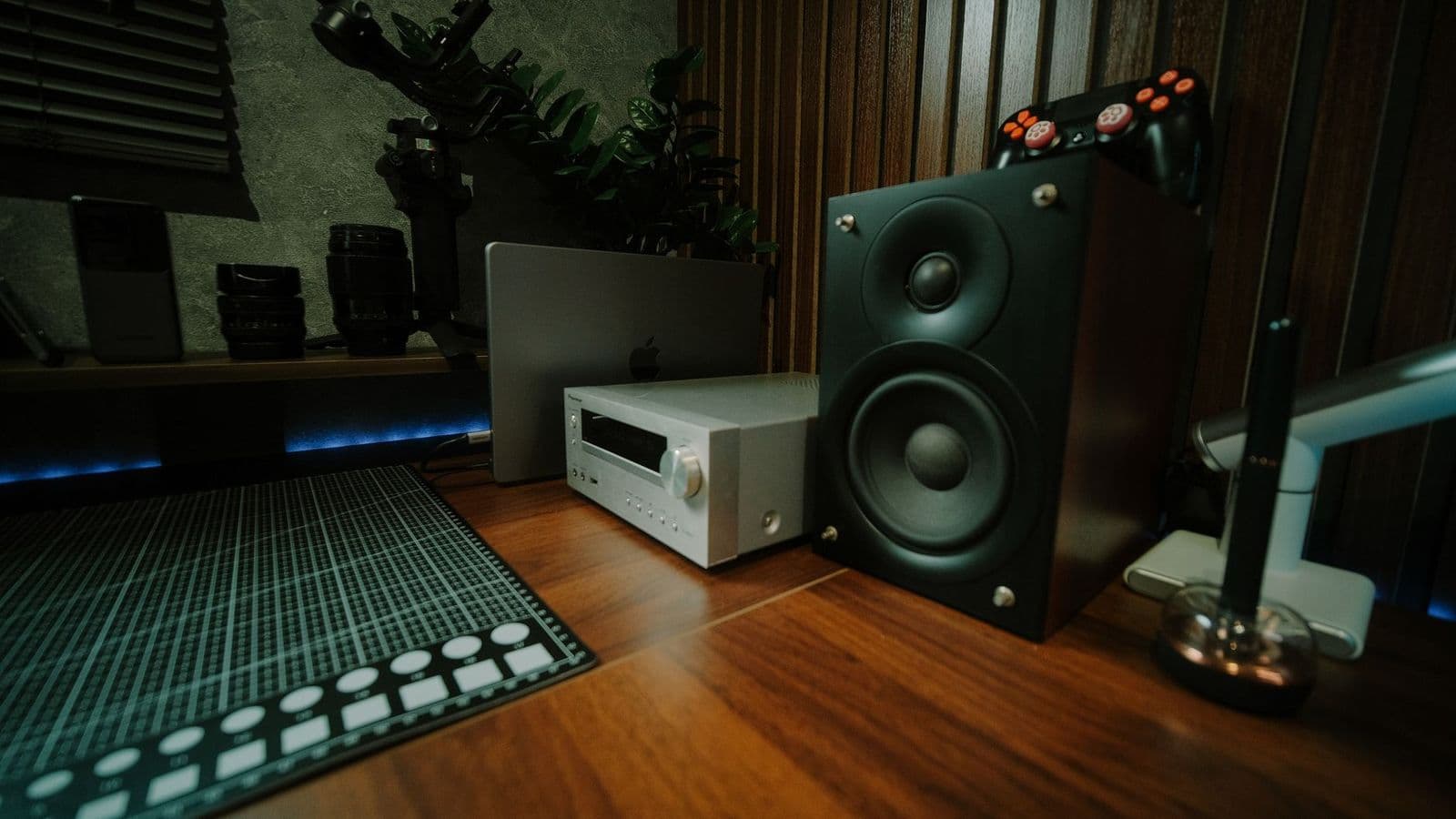
Gaming setups place speakers close, often on a desk beside a monitor, so the priorities are compact size, clear dialogue at low volume, and a soundstage that positions effects accurately. Component sets suit this well because the tweeters can angle toward your ears while the woofers sit lower. The limitation is bass for explosions and scores, which small woofers cannot supply alone. Many desk listeners pair this type with a small subwoofer under the desk for the lowest notes.
Wireless and Bluetooth Based Systems
A truly wireless component set does not exist, because the drivers need wired power from an amplifier. What sellers mean by this label is a component set bundled or paired with a Bluetooth equipped amplifier or powered enclosure. The speakers remain passive and wired. Judge such bundles in two parts: the driver and crossover quality, which follows this guide, and the amplifier features, which deserve their own check. This split matters at upgrade time, since you can replace the amplifier later and keep the speakers.
Home and Bookshelf Models
Bookshelf oriented sets assume a stable shelf, a stereo amplifier, and a seated listener, so they favor smooth tone and finish quality over weather resistance. They often include finished enclosures rather than bare drivers, which removes guesswork about box volume. Choose this family for bedrooms, studies, and small listening corners. Avoid it for car doors, where the enclosure will not fit and the materials are not built for heat and moisture. For a broader look at the size class, see the best 4 inch speakers.
Care and Maintenance Tips
- Dust cones and tweeter domes with a soft, dry brush, since trapped grit can buzz at certain frequencies.
- Keep connections tight and clean, and remake any terminal that shows corrosion, especially in car doors.
- Avoid maximum volume for long sessions, because heat builds in voice coils and ages adhesives faster.
- Store spare drivers and crossovers in a dry box with the original gaskets, away from sunlight.
- Recheck placement after moving furniture or seats, since a few inches of change alters the stereo image.
- If you use a streaming amplifier, keep its firmware current so source features and protections stay up to date.
FAQs
What IP rating do I need for outdoor use of component speakers?
You need a set that actually carries a rating, and most home and car component sets carry none. For a covered porch, moisture resistant cones and surrounds may suffice, but direct rain calls for products engineered and rated for exposure. A rating such as IP65 or higher indicates real protection against water jets and dust. Rather than forcing an indoor set outside, choose a purpose built outdoor or marine model, because a failed woofer costs more than the right purchase would have.
Do I need a special codec for component speakers?
No codec touches the speakers themselves, because codecs describe how a Bluetooth source compresses audio before sending it to an amplifier. Your component set simply plays the analog signal it receives. If you stream over Bluetooth, a source and amplifier that share a higher quality codec pass a cleaner signal, and revealing speakers will show the difference. For critical listening, a wired connection from source to amplifier removes the question entirely, which is one reason component systems remain popular with careful listeners.
How long does the battery last in component speakers?
There is no battery, because component speakers are passive and draw power from your amplifier while they play. The useful lifespan question is mechanical. Surrounds, adhesives, and crossover parts age with heat and humidity, and a set kept in a mild indoor room can sound right for fifteen years or more. In a car, plan on a shorter horizon. If a product page promises hours of play time, it is describing a portable powered speaker, not a component set.
Wired or wireless: which sounds better for component speakers?
Wired sounds better and is the only option at the speaker itself, since passive drivers need wired power to move. Wireless convenience enters the system at the source, where a phone streams to an amplifier, and any quality loss happens at that hop rather than at the speaker cables. Short, sound speaker wire runs lose effectively nothing. So build the system wired from amplifier to speakers, and choose your source connection based on convenience, knowing the speakers will faithfully reveal either choice.
Is ANC worth the extra cost for component speakers?
Active noise cancellation is not offered in passive component speakers, so there is no ANC upgrade to buy in this category. Room and cabin noise are handled passively instead: seals, deadening, soft surfaces, and sensible volume. That approach has a side benefit, because a quieter space improves every source you own, not just one product. If a listing for component speakers charges extra for noise cancellation, treat the claim as a warning sign about the accuracy of the whole listing and shop for a more honest set. Our vehicle specific guide to the best 4 inch car speakers covers cabin noise treatments in context.
Final Thoughts
Decide by crossover quality, honest RMS handling, and fit in all three mounting spots, and most sets will sort themselves quickly. Match the profile to your space and amplifier, and the best 4 inch component speakers for your setup will be the set that images cleanly and asks nothing more of you for years.